


Page 213 - Read Online
P. 213
Page 12 of 15            Xie et al. Energy Mater. 2025, 5, 500127  https://dx.doi.org/10.20517/energymater.2025.48


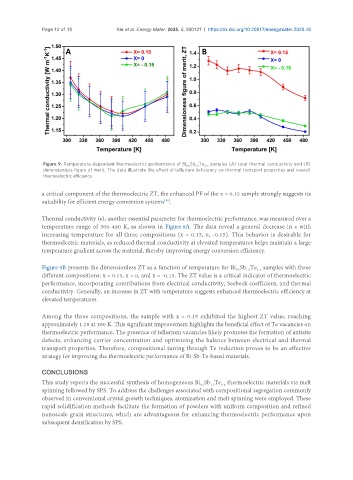
                Figure 9. Temperature-dependent thermoelectric performance of Bi Sb Te  samples (A) total thermal conductivity and (B)
                                                                0.5
                                                                   1.5
                                                                      3-x
                dimensionless figure of merit. The data illustrate the effect of tellurium deficiency on thermal transport properties and overall
                thermoelectric efficiency.
               a critical component of the thermoelectric ZT, the enhanced PF of the x = 0.15 sample strongly suggests its
                                                        [42]
               suitability for efficient energy conversion systems .
               Thermal conductivity (κ), another essential parameter for thermoelectric performance, was measured over a
               temperature range of 300-480 K, as shown in Figure 9A. The data reveal a general decrease in κ with
               increasing temperature for all three compositions (x = 0.15, 0, -0.15). This behavior is desirable for
               thermoelectric materials, as reduced thermal conductivity at elevated temperatures helps maintain a large
               temperature gradient across the material, thereby improving energy conversion efficiency.


               Figure 9B presents the dimensionless ZT as a function of temperature for Bi Sb Te  samples with three
                                                                                        3-x
                                                                                    1.5
                                                                                 0.5
               different compositions: x = 0.15, x = 0, and x = -0.15. The ZT value is a critical indicator of thermoelectric
               performance, incorporating contributions from electrical conductivity, Seebeck coefficient, and thermal
               conductivity. Generally, an increase in ZT with temperature suggests enhanced thermoelectric efficiency at
               elevated temperatures.

               Among the three compositions, the sample with x = 0.15 exhibited the highest ZT value, reaching
               approximately 1.18 at 360 K. This significant improvement highlights the beneficial effect of Te vacancies on
               thermoelectric performance. The presence of tellurium vacancies likely promotes the formation of antisite
               defects, enhancing carrier concentration and optimizing the balance between electrical and thermal
               transport properties. Therefore, compositional tuning through Te reduction proves to be an effective
               strategy for improving the thermoelectric performance of Bi-Sb-Te-based materials.


               CONCLUSIONS
               This study reports the successful synthesis of homogeneous Bi Sb Te  thermoelectric materials via melt
                                                                            3-x
                                                                     0.5
                                                                        1.5
               spinning followed by SPS. To address the challenges associated with compositional segregation commonly
               observed in conventional crystal growth techniques, atomization and melt spinning were employed. These
               rapid solidification methods facilitate the formation of powders with uniform composition and refined
               nanoscale grain structures, which are advantageous for enhancing thermoelectric performance upon
               subsequent densification by SPS.

