


Page 138 - Read Online
P. 138
Page 14 of 21          Chen et al. Energy Mater. 2025, 5, 500120  https://dx.doi.org/10.20517/energymater.2024.311


                                                                             [56]
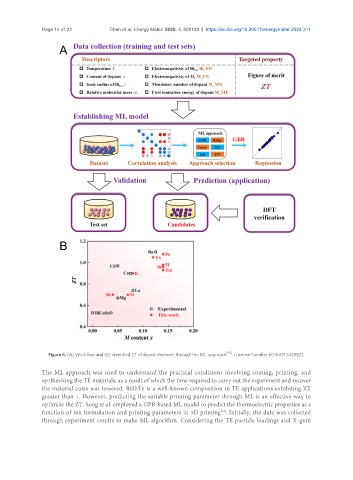
                 Figure 6. (A) Workflow and (B) identified ZT of doped elements through the ML approach  . (License Number 6015491243882).

               The ML approach was used to understand the practical conditions involving coating, printing, and
               synthesizing the TE materials, as a result of which the time required to carry out the experiment and recover
               the material costs was lowered. BiSbTe is a well-known composition in TE applications exhibiting ZT
               greater than 1. However, predicting the suitable printing parameter through ML is an effective way to
               optimize the ZT. Song et al. employed a GPR-based ML model to predict the thermoelectric properties as a
                                                                           [61]
               function of ink formulation and printing parameters in 3D printing . Initially, the data was collected
               through experiment results to make ML algorithm. Considering the TE particle loadings and X-gum

