


Page 133 - Read Online
P. 133
Page 10 of 21          Chen et al. Energy Mater. 2025, 5, 500120  https://dx.doi.org/10.20517/energymater.2024.311

                                          -1
                                        -1
               them, 6 has κ less than 2 Wm K . From these, a material PdBr  was identified with a high power factor and
                          l
                                                                    2
               low lattice thermal conductivity. LASSO helped to screen the descriptor in relation to electronic transport
               parameters. The higher accuracies were obtained through the elemental and bonding descriptors. The
               transport parameters σ and S revealed the dependency relation with coordination number, boiling point,
               the heat of formation, and molar-specific heat coming under the bonding descriptor. From this, σ and S
               commonly relate to the bond strength. Further, κ shows a close relation with the coordination number
                                                          l
               through anharmonicity. Volume is inversely correlated with the κ. Hence, electronegativity, bond strength,
                                                                       l
               bond distance, volume, and coordination number have an excellent correlation with the electronic and
               thermal transport properties related to the chemical bonding descriptor. In conclusion, the chemical
               bonding-driven descriptor is a key point to connect the electronic and thermal transport properties. These
               reports find a common relation that could help to understand future experimental research in this domain.
               A total of 2,838 compounds were taken from different groups of materials: alkaline, transition, alkali, and
               lanthanide elements, and these were screened based on the band gap and phonon frequency; after that, 185
               compounds were found to be nonmetallic and stable. Figure 5 illustrates the screening process, which
               includes the optimization, band gap, and phonon frequency. Also, another report has verified the relation
               between chemical bonding characteristics and κ.  In this, the coordination number had a high value when
                                                        l
               the bond strength was weak and the bond distance was large .
                                                                  [53]

               Various atomic characteristics of materials that change the TE properties lead to identifying their
               relationship. Indeed, ML reduces the cost of material synthesis by predicting this relation. Li et al. applied
               the ML approach to analyze the TE performance of high entropy GeTe materials by correlating atomic
               features and the ZT . Nine atomic features were selected for this analysis: atomic number, ionization
                                 [54]
               energy, pseudopotential radius, atomic radius, electronegativity, electron affinity energy, molar volume,
               number of valence electrons, and atomic weight. Each element's atomic fraction is treated as a weighted
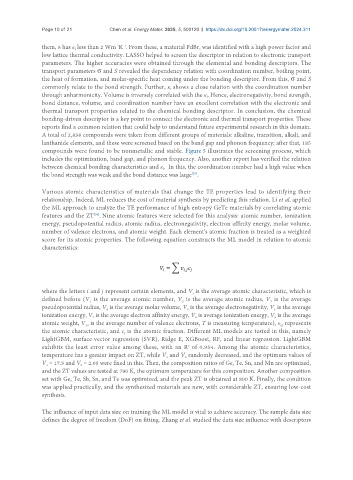
               score for its atomic properties. The following equation constructs the ML model in relation to atomic
               characteristics:


               where the letters i and j represent certain elements, and V is the average atomic characteristic, which is
                                                                  i
               defined before (V  is the average atomic number, V  is the average atomic radius, V  is the average
                                                              2
                               1
                                                                                            3
               pseudopotential radius, V  is the average molar volume, V  is the average electronegativity, V  is the average
                                     4
                                                                5
                                                                                             6
               ionization energy, V  is the average electron affinity energy, V  is average ionization energy, V  is the average
                                7
                                                                                              9
                                                                   8
               atomic weight, V  is the average number of valence electrons, T is measuring temperature), υ  represents
                                                                                                i,j
                              10
               the atomic characteristic, and c  is the atomic fraction. Different ML models are tested in this, namely
                                           j
               LightGBM, surface vector regression (SVR), Ridge E, XGBoost, RF, and linear regression. LightGBM
                                                                2
               exhibits the least error value among these, with an R  of 0.954. Among the atomic characteristics,
               temperature has a greater impact on ZT, while V  and V  randomly decreased, and the optimum values of
                                                               5
                                                         4
               V  = 17.5 and V  = 2.05 were fixed in this. Then, the composition ratios of Ge, Te, Sn, and Mn are optimized,
                            5
                 4
               and the ZT values are tested at 790 K, the optimum temperature for this composition. Another composition
               set with Ge, Te, Sb, Sn, and Te was optimized, and the peak ZT is obtained at 800 K. Finally, the condition
               was applied practically, and the synthesized materials are new, with considerable ZT, ensuring low-cost
               synthesis.
               The influence of input data size on training the ML model is vital to achieve accuracy. The sample data size
               defines the degree of freedom (DoF) on fitting. Zhang et al. studied the data size influence with descriptors

