


Page 137 - Read Online
P. 137
Chen et al. Energy Mater. 2025, 5, 500120  https://dx.doi.org/10.20517/energymater.2024.311  Page 13 of 21


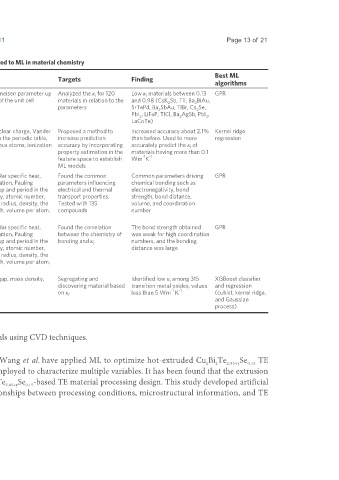
 Table 1. The survey of this review refers to the descriptors, targets, and findings of the study related to ML in material chemistry

 Sample                                                                      Best ML
 Publication  Samples  Descriptors  Targets    Finding
 source                                                                      algorithms
 [51]
 Juneja et al., 2019  Material   2,162 binary, ternary, and  Maximum phonon frequency, integrated Gruneisen parameter up  Analyzed the κ for 120   Low κ materials between 0.13   GPR
                                  l                 l
 project  quaternary compounds  to 3 THz, average atomic mass, and volume of the unit cell  materials in relation to the   and 0.98 (CsK Sb, TlI, Ba BiAu,
                                                                     2
                                                            2
                     parameters                SrTePd, Ba SbAu, TlBr, Cs Se,
                                                         2
                                                                      2
                                               PbI , LiFeP, TlCl, Ba AgSb, PbI ,
                                                  2             2        2
                                               LaCoTe)
 [55]
 Zhang et al., 2018  Previous   93 binary   Electronegativity, atomic radius, effective nuclear charge, Vander  Proposed a method to   Increased accuracy about 2.1%  Kernel ridge
 reports  semiconductors  Waals radius, covalent radius, row number in the periodic table,   increase prediction   than before. Used to more   regression
 block number, enthalpy of formation of gaseous atoms, ionization  accuracy by incorporating   accurately predict the κ of
                                                                    l
 energy, and valence number  property estimation in the   materials having more than 0.1
                                                   -1 -1
                     feature space to establish   Wm K
                     ML models
 [52]
 Juneja et al., 2020  DFT +   2,838 compounds  Boiling point, melting point, specific heat, molar specific heat,   Found the common   Common parameters driving   GPR
 Boltztrap   molar volume, heat of fusion, heat of vaporization, Pauling   parameters influencing   chemical bonding such as
 code  electronegativity, first ionization energy, group and period in the   electrical and thermal   electronegativity, bond
 periodic table, elemental thermal conductivity, atomic number,   transport properties.   strength, bond distance,
 atomic mass, covalent radius, van der Waals radius, density, the   Tested with 135   volume, and coordination
 average bond distance, average bond strength, volume per atom,   compounds  number
 volume of cell, and coordination number
 [53]
 Juneja et al., 2020  DFT  2,838 nonmetallic   Boiling point, melting point, specific heat, molar specific heat,   Found the correlation   The bond strength obtained   GPR
 compounds after high   molar volume, heat of fusion, heat of vaporization, Pauling   between the chemistry of   was weak for high coordination
 throughput screening 185  electronegativity, first ionization energy, group and period in the   bonding and κ  numbers, and the bonding
                                  l
 compounds were   periodic table, elemental thermal conductivity, atomic number,   distance was large
 analyzed  atomic mass, covalent radius, van der Waals radius, density, the
 average bond distance, average bond strength, volume per atom,
 volume of cell, and coordination number
 [50]
 Tewari et al., 2020  DFT  315 compounds  lattice energy per atom, atom density, band gap, mass density,   Segregating and   Identified low κ among 315   XGBoost classifier
                                                             l
 and oxygen ratio by transition metal atoms  discovering material based  transition metal oxides, values   and regression
                                                             -1  -1
                     on κ                      less than 5 Wm  K             (cubist, kernel ridge,
                         l
                                                                             and Gaussian
                                                                             process)


 potential to be expanded to efficient synthesis of chalcogenide-based TE materials using CVD techniques.


 Among chalcogenides, Bi Te -based materials show the best TE properties. Wang et al. have applied ML to optimize hot-extruded Cu Bi Te 2.85+y Se  TE
                                                                         x
                                                                             2
                                                                                        0.15
 3
 2
 materials for the first time . Principal component analysis (PCA) has been employed to characterize multiple variables. It has been found that the extrusion
 [60]
 temperature and Cu content are the most important parameters in the Cu Bi Te 2.85+y Se -based TE material processing design. This study developed artificial
 2
          0.15
 x
 neural network (ANN), SVR, and RF regression models to analyze the relationships between processing conditions, microstructural information, and TE
 properties.

