


Page 140 - Read Online
P. 140
Page 16 of 21          Chen et al. Energy Mater. 2025, 5, 500120  https://dx.doi.org/10.20517/energymater.2024.311


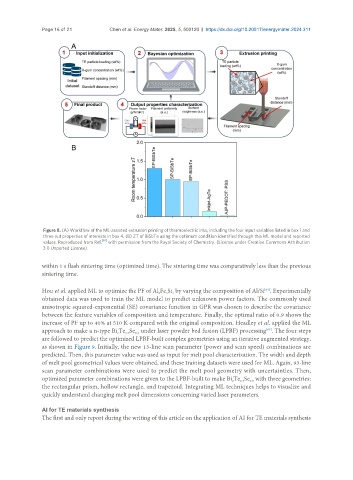
                Figure 8. (A) Workflow of the ML-assisted extrusion printing of thermoelectric inks, including the four input variables listed in box 1 and
                three out properties of interests in box 4, (B) ZT of BiSbTe using the optimum condition identified through this ML model and reported
                values. Reproduced from Ref. [61]  with permission from the Royal Society of Chemistry. (License under Creative Commons Attribution
                3.0 Unported License).

               within 1 s flash sintering time (optimized time). The sintering time was comparatively less than the previous
               sintering time.

                                                                                          [64]
               Hou et al. applied ML to optimize the PF of Al Fe Si  by varying the composition of Al/Si . Experimentally
                                                           3
                                                      2
                                                         3
               obtained data was used to train the ML model to predict unknown power factors. The commonly used
               anisotropic squared-exponential (SE) covariance function in GPR was chosen to describe the covariance
               between the feature variables of composition and temperature. Finally, the optimal ratio of 0.9 shows the
               increase of PF up to 40% at 510 K compared with the original composition. Headley et al. applied the ML
               approach to make a n-type Bi Te Se  under laser powder bed fusion (LPBF) processing . The four steps
                                                                                           [63]
                                        2
                                               0.3
                                           2.7
               are followed to predict the optimized LPBF-built complex geometries using an iterative augmented strategy,
               as shown in Figure 9. Initially, the new 13-line scan parameter (power and scan speed) combinations are
               predicted. Then, this parameter value was used as input for melt pool characterization. The width and depth
               of melt pool geometrical values were obtained, and these training datasets were used for ML. Again, 93-line
               scan parameter combinations were used to predict the melt pool geometry with uncertainties. Then,
               optimized parameter combinations were given to the LPBF-built to make Bi Te Se  with three geometries:
                                                                               2
                                                                                     0.3
                                                                                  2.7
               the rectangular prism, hollow rectangle, and trapezoid. Integrating ML techniques helps to visualize and
               quickly understand changing melt pool dimensions concerning varied laser parameters.
               AI for TE materials synthesis
               The first and only report during the writing of this article on the application of AI for TE materials synthesis

