


Page 132 - Read Online
P. 132
Chen et al. Energy Mater. 2025, 5, 500120  https://dx.doi.org/10.20517/energymater.2024.311  Page 9 of 21


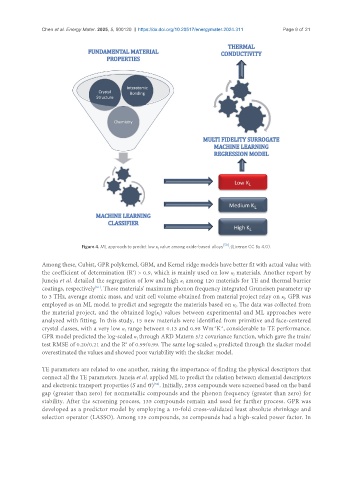
                             Figure 4. ML approach to predict low κ value among oxide-based alloys [50] . (License CC By 4.0).
                                                      l
               Among these, Cubist, GPR polykernel, GBM, and Kernel ridge models have better fit with actual value with
               the coefficient of determination (R ) > 0.9, which is mainly used on low κ materials. Another report by
                                              2
                                                                                l
               Juneja et al. detailed the segregation of low and high κ among 120 materials for TE and thermal barrier
                                                               l
                                 [51]
               coatings, respectively . These materials' maximum phonon frequency integrated Gruneisen parameter up
               to 3 THz, average atomic mass, and unit cell volume obtained from material project relay on κ. GPR was
                                                                                                 l
               employed as an ML model to predict and segregate the materials based on κ. The data was collected from
                                                                                l
               the material project, and the obtained log(κ) values between experimental and ML approaches were
                                                       l
               analyzed with fitting. In this study, 15 new materials were identified from primitive and face-centered
               crystal classes, with a very low κ range between 0.13 and 0.98 Wm K , considerable to TE performance.
                                                                         -1
                                                                           -1
                                           l
               GPR model predicted the log-scaled κ through ARD Matern 5/2 covariance function, which gave the train/
                                               l
               test RMSE of 0.20/0.21 and the R  of 0.99/0.99. The same log-scaled κ predicted through the slacker model
                                           2
                                                                          l
               overestimated the values and showed poor variability with the slacker model.
               TE parameters are related to one another, raising the importance of finding the physical descriptors that
               connect all the TE parameters. Juneja et al. applied ML to predict the relation between elemental descriptors
               and electronic transport properties (S and σ) . Initially, 2838 compounds were screened based on the band
                                                     [52]
               gap (greater than zero) for nonmetallic compounds and the phonon frequency (greater than zero) for
               stability. After the screening process, 135 compounds remain and used for further process. GPR was
               developed as a predictor model by employing a 10-fold cross-validated least absolute shrinkage and
               selection operator (LASSO). Among 135 compounds, 34 compounds had a high-scaled power factor. In

