


Page 117 - Read Online
P. 117
Ashani et al. Energy Mater. 2025, 5, 500111  https://dx.doi.org/10.20517/energymater.2025.10  Page 7 of 13

               Table 1. The calculated intrinsic parameters for hole and electron carriers in the spin-up channel for the energy and temperature-
               dependent relaxation time
                                                                                     -3
                                                               -1
                Orientation   Carrier type   DP    m*/m    V (ms )   ε  ∞  ε L  Ρ (kgm )    ħω  (meV)
                                                                                              LO
                x             Hole           2.59  0.14    7752      1.89  3.67  3410       70
                              Electron       1.09  0.13    7752      1.89  3.67  3410       70
                y             Hole           3.05  0.09    7752      1.89  3.67  3410       70
                              Electron       1.69  0.12    7752      1.89  3.67  3410       70

               DP: Deformation potential.

               Table 2. The calculated intrinsic parameters for the energy-dependent relaxation time in the spin-down channel for hole and electron
               carriers
                                                                                     -3
                                                               -1
                Orientation   Carrier type   DP    m*/m    V (ms )   ε ∞  ε L   Ρ (kgm )    ħω  (meV)
                                                                                              LO
                x             Hole           3     0.09    7752      1.89  3.67  3410       70
                              Electron       1.64  0.11    7752      1.89  3.67  3410       70
                y             Hole           2.64  0.15    7752      1.89  3.67  3410       70
                              Electron       1.14  0.16    7752      1.89  3.67  3410       70

               DP: Deformation potential.


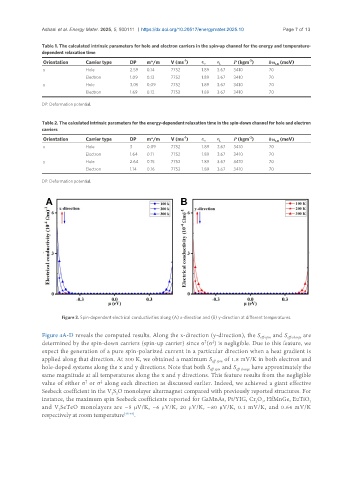
                      Figure 3. Spin-dependent electrical conductivities along (A) x-direction and (B) y-direction at different temperatures.


               Figure 4A-D reveals the computed results. Along the x-direction (y-direction), the S eff-spin  and S eff-charge  are
               determined by the spin-down carriers (spin-up carrier) since σ (σ ) is negligible. Due to this feature, we
                                                                      ↑
                                                                         ↓
               expect the generation of a pure spin-polarized current in a particular direction when a heat gradient is
               applied along that direction. At 300 K, we obtained a maximum S eff-spin  of 1.8 mV/K in both electron and
               hole-doped systems along the x and y directions. Note that both S eff-spin  and S eff-charge  have approximately the
               same magnitude at all temperatures along the x and y directions. This feature results from the negligible
               value of either σ  or σ  along each direction as discussed earlier. Indeed, we achieved a giant effective
                              ↑
                                   ↓
               Seebeck coefficient in the V S O monolayer altermagnet compared with previously reported structures. For
                                       2 2
               instance, the maximum spin Seebeck coefficients reported for GaMnAs, Pt/YIG, Cr O , HfMnGe, EuTiO 3
                                                                                         3
                                                                                       2
               and V SeTeO monolayers are ~5  μV/K, ~6  μV/K, 20  μV/K, ~80  μV/K, 0.1 mV/K, and 0.64 mV/K
                     2
               respectively at room temperature [45-49] .

