


Page 113 - Read Online
P. 113
Ashani et al. Energy Mater. 2025, 5, 500111  https://dx.doi.org/10.20517/energymater.2025.10  Page 3 of 13

               25 Å along the z-axis to prevent adjacent units’ interaction. The Heyd-Scuseria-Ernzerhof screened hybrid
               functional was used to calculate the spin-polarized electronic band structure [36,37] . To estimate the critical
               temperature, we applied a simulation of the field cooling and Landau-Lifshitz-Gilbert Huen method as
                                                               [38]
               implemented  in  the  VAMPIRE  simulation  package   for  the  temperature-dependent  sub-lattice
               magnetization calculation. To this end, a supercell of 100 × 100 × 1 with total time steps of 100,000 and 0.1 fs
                                                                                                        [39]
               is used. Our directional spin-dependent transport properties were explored using the BoltzTraP code .
               Since most of the transport properties are carrier relaxation time (τ) dependent, we considered the
               scattering contributions from the impurity effects (τ )  polar optical phonon (τ ), and acoustic phonon
                                                            imp
                                                                                    opt
               (τ ). Therefore, the total τ, which depends on energy and temperature, can be expressed as:
                 aco
                                                                                                        (1)


               In addition, we also computed the lattice part of the thermal conductivity with phono3py code  using a
                                                                                                 [40]
               4 × 4 × 1 supercell, 6 × 6 × 1 K-mesh, and energy cutoff 600 eV.

               RESULTS AND DISCUSSION
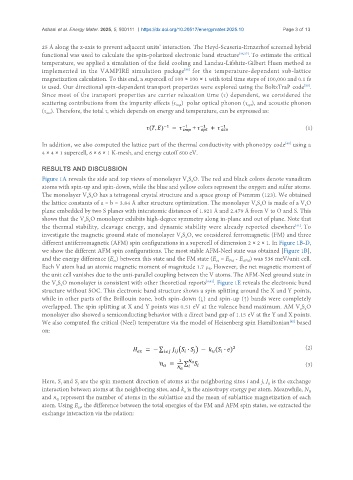
               Figure 1A reveals the side and top views of monolayer V S O. The red and black colors denote vanadium
                                                                2 2
               atoms with spin-up and spin-down, while the blue and yellow colors represent the oxygen and sulfur atoms.
               The monolayer V S O has a tetragonal crystal structure and a space group of P4mmm (123). We obtained
                              2 2
               the lattice constants of a = b = 3.84 Å after structure optimization. The monolayer V S O is made of a V O
                                                                                                        2
                                                                                       2 2
               plane embedded by two S planes with interatomic distances of 1.921 Å and 2.479 Å from V to O and S. This
               shows that the V S O monolayer exhibits high-degree symmetry along in-plane and out of plane. Note that
                             2 2
               the thermal stability, cleavage energy, and dynamic stability were already reported elsewhere . To
                                                                                                     [41]
               investigate the magnetic ground state of monolayer V S O, we considered ferromagnetic (FM) and three
                                                              2 2
               different antiferromagnetic (AFM) spin configurations in a supercell of dimension 2 × 2 × 1. In Figure 1B-D,
               we show the different AFM spin configurations. The most stable AFM-Neel state was obtained [Figure 1B],
               and the energy difference (E ) between this state and the FM state (E  = E  - E ) was 536 meV/unit cell.
                                                                                   AFM
                                       ex
                                                                              FM
                                                                          ex
               Each V atom had an atomic magnetic moment of magnitude 1.7 μ . However, the net magnetic moment of
                                                                       B
               the unit cell vanishes due to the anti-parallel coupling between the V atoms. The AFM-Neel ground state in
               the V S O monolayer is consistent with other theoretical reports [6,41] . Figure 1E reveals the electronic band
                    2 2
               structure without SOC. This electronic band structure shows a spin splitting around the X and Y points,
               while in other parts of the Brillouin zone, both spin-down (↓) and spin-up (↑) bands were completely
               overlapped. The spin splitting at X and Y points was 0.51 eV at the valence band maximum. AM V S O
                                                                                                      2 2
               monolayer also showed a semiconducting behavior with a direct band gap of 1.15 eV at the Y and X points.
               We also computed the critical (Neel) temperature via the model of Heisenberg spin Hamiltonian  based
                                                                                                   [42]
               on:
                                                                                                        (2)


                                                                                                        (3)

               Here, S and S are the spin moment direction of atoms at the neighboring sites i and j, J  is the exchange
                           j
                     i
                                                                                           ij
               interaction between atoms at the neighboring sites, and k  is the anisotropy energy per atom. Meanwhile, N α
                                                               u
               and n  represent the number of atoms in the sublattice and the mean of sublattice magnetization of each
                    α
               atom. Using E , the difference between the total energies of the FM and AFM spin states, we extracted the
                           ex
               exchange interaction via the relation:

