


Page 114 - Read Online
P. 114
Page 4 of 13           Ashani et al. Energy Mater. 2025, 5, 500111  https://dx.doi.org/10.20517/energymater.2025.10


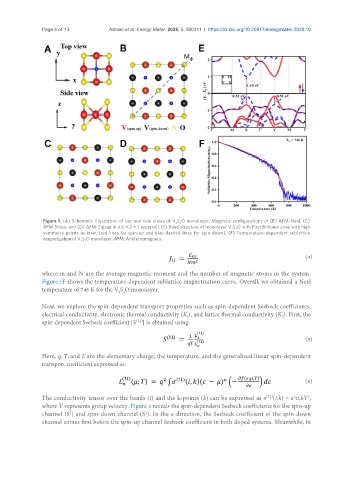
                Figure 1. (A) Schematic illustration of top and side views of V S O monolayer. Magnetic configurations of (B) AFM-Neel, (C)
                                                            2 2
                AFM-Stripy, and (D) AFM-Zigzag in a 2 × 2 × 1 supercell; (E) Band structure of monolayer V S O with First Brillouin zone with high
                                                                               2 2
                symmetry points as inset (red lines for spin-up and blue dashed-lines for spin-down); (F) Temperature-dependent sublattice
                magnetization of V S O monolayer. AFM: Antiferromagnetic.
                            2 2
                                                                                                        (4)


               where m and N are the average magnetic moment and the number of magnetic atoms in the system.
               Figure 1F shows the temperature-dependent sublattice magnetization curve. Overall, we obtained a Neel
               temperature of 746 K for the V S O monolayer.
                                         2 2

               Now, we explore the spin-dependent transport properties such as spin-dependent Seebeck coefficients,
               electrical conductivity, electronic thermal conductivity (K ), and lattice thermal conductivity (K ). First, the
                                                                e
                                                                                                L
               spin-dependent Seebeck coefficient [S ] is obtained using:
                                               (↑↓)
                                                                                                        (5)

               Here, q, T, and L are the elementary charge, the temperature, and the generalized linear spin-dependent
               transport coefficient expressed as:

                                                                                                        (6)


               The conductivity tensor over the bands (i) and the k-points (k) can be expressed as σ (i,k) = e τi,kV ,
                                                                                                         2
                                                                                           (↑↓)
                                                                                                    2
               where V represents group velocity. Figure 2 reveals the spin-dependent Seebeck coefficients for the spin-up
               channel (S ) and spin-down channel (S ). In the x-direction, the Seebeck coefficient of the spin-down
                        ↑
                                                  ↓
               channel comes first before the spin-up channel Seebeck coefficient in both doped systems. Meanwhile, in

