


Page 116 - Read Online
P. 116
Page 6 of 13           Ashani et al. Energy Mater. 2025, 5, 500111  https://dx.doi.org/10.20517/energymater.2025.10

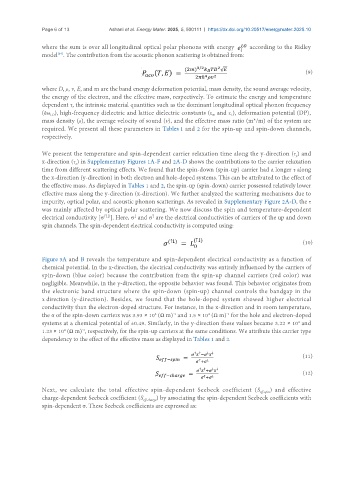
               where the sum is over all longitudinal optical polar phonons with energy        according to the Ridley
                    [39]
               model . The contribution from the acoustic phonon scattering is obtained from:
                                                                                                        (9)


               where D, ρ, v, E, and m are the band energy deformation potential, mass density, the sound average velocity,
               the energy of the electron, and the effective mass, respectively. To estimate the energy and temperature
               dependent τ, the intrinsic material quantities such as the dominant longitudinal optical phonon frequency
               (ħω ), high-frequency dielectric and lattice dielectric constants (ε  and ε ), deformation potential (DP),
                                                                         ∞
                                                                               L
                  LO
               mass density (ρ), the average velocity of sound (v), and the effective mass ratio (m*/m) of the system are
               required. We present all these parameters in Tables 1 and 2 for the spin-up and spin-down channels,
               respectively.

               We present the temperature and spin-dependent carrier relaxation time along the y-direction (τ ) and
                                                                                                     y
               x-direction (τ ) in Supplementary Figures 1A-F and 2A-D shows the contributions to the carrier relaxation
                          x
               time from different scattering effects. We found that the spin-down (spin-up) carrier had a longer τ along
               the x-direction (y-direction) in both electron and hole-doped systems. This can be attributed to the effect of
               the effective mass. As displayed in Tables 1 and 2, the spin-up (spin-down) carrier possessed relatively lower
               effective mass along the y-direction (x-direction). We further analyzed the scattering mechanisms due to
               impurity, optical polar, and acoustic phonon scatterings. As revealed in Supplementary Figure 2A-D, the τ
               was mainly affected by optical polar scattering. We now discuss the spin and temperature-dependent
                                    (↑↓)
                                              ↓
                                                    ↑
               electrical conductivity [σ ]. Here, σ  and σ  are the electrical conductivities of carriers of the up and down
               spin channels. The spin-dependent electrical conductivity is computed using:
                                                                                                       (10)


               Figure 3A and B reveals the temperature and spin-dependent electrical conductivity as a function of
               chemical potential. In the x-direction, the electrical conductivity was entirely influenced by the carriers of
               spin-down (blue color) because the contribution from the spin-up channel carriers (red color) was
               negligible. Meanwhile, in the y-direction, the opposite behavior was found. This behavior originates from
               the electronic band structure where the spin-down (spin-up) channel controls the bandgap in the
               x direction (y-direction). Besides, we found that the hole-doped system showed higher electrical
               conductivity than the electron-doped structure. For instance, in the x-direction and in room temperature,
                                                           -1
                                                     4
                                                                       4
                                                                             -1
               the σ of the spin-down carriers was 3.93 × 10  (Ω m)  and 1.5 × 10  (Ω m)  for the hole and electron-doped
               systems at a chemical potential of ±0.49. Similarly, in the y-direction these values became 3.22 × 10  and
                                                                                                      4
               1.23 × 10  (Ω m) , respectively, for the spin-up carriers at the same conditions. We attribute this carrier type
                       4
                             -1
               dependency to the effect of the effective mass as displayed in Tables 1 and 2.
                                                                                                       (11)
                                                                                                       (12)

               Next,  we  calculate  the  total  effective  spin-dependent  Seebeck  coefficient  (S eff-spin )  and  effective
               charge-dependent Seebeck coefficient (S eff-charge ) by associating the spin-dependent Seebeck coefficients with
               spin-dependent σ. These Seebeck coefficients are expressed as:

