


Page 120 - Read Online
P. 120
Page 10 of 13          Ashani et al. Energy Mater. 2025, 5, 500111  https://dx.doi.org/10.20517/energymater.2025.10


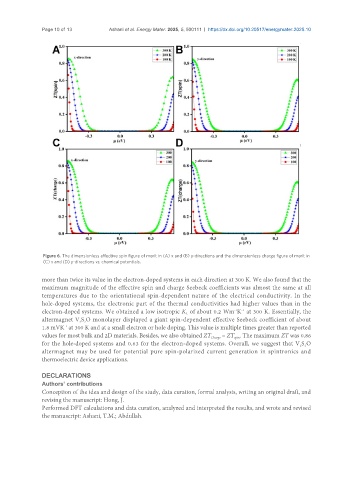
                Figure 6. The dimensionless effective spin figure of merit in (A) x and (B) y-directions and the dimensionless charge figure of merit in
                (C) x and (D) y-directions vs. chemical potentials.

               more than twice its value in the electron-doped systems in each direction at 300 K. We also found that the
               maximum magnitude of the effective spin and charge Seebeck coefficients was almost the same at all
               temperatures due to the orientational spin-dependent nature of the electrical conductivity. In the
               hole-doped systems, the electronic part of the thermal conductivities had higher values than in the
                                                                                -1
               electron-doped systems. We obtained a low isotropic K  of about 0.2 Wm K  at 300 K. Essentially, the
                                                                                  -1
                                                                L
               altermagnet V S O monolayer displayed a giant spin-dependent effective Seebeck coefficient of about
                            2 2
               1.8 mVK  at 300 K and at a small electron or hole doping. This value is multiple times greater than reported
                       -1
               values for most bulk and 2D materials. Besides, we also obtained ZT Charge  = ZT . The maximum ZT was 0.86
                                                                                spin
               for the hole-doped systems and 0.63 for the electron-doped systems. Overall, we suggest that V S O
                                                                                                      2 2
               altermagnet may be used for potential pure spin-polarized current generation in spintronics and
               thermoelectric device applications.
               DECLARATIONS
               Authors’ contributions
               Conception of the idea and design of the study, data curation, formal analysis, writing an original draft, and
               revising the manuscript: Hong, J.
               Performed DFT calculations and data curation, analyzed and interpreted the results, and wrote and revised
               the manuscript: Ashani, T.M.; Abdullah.

