


Page 115 - Read Online
P. 115
Ashani et al. Energy Mater. 2025, 5, 500111  https://dx.doi.org/10.20517/energymater.2025.10  Page 5 of 13


                                                    ↓
                                                ↑
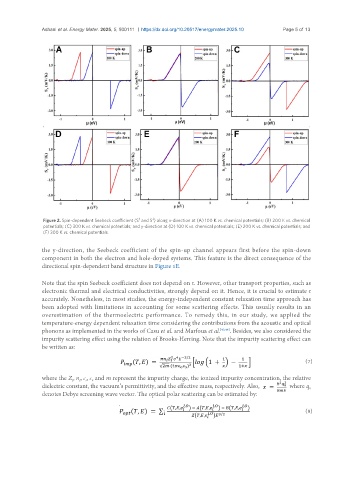
                Figure 2. Spin-dependent Seebeck coefficient (S  and S ) along x-direction at (A) 100 K vs. chemical potentials; (B) 200 K vs. chemical
                potentials; (C) 300 K vs. chemical potentials; and y-direction at (D) 100 K vs. chemical potentials; (E) 200 K vs. chemical potentials; and
                (F) 300 K vs. chemical potentials.
               the y-direction, the Seebeck coefficient of the spin-up channel appears first before the spin-down
               component in both the electron and hole-doped systems. This feature is the direct consequence of the
               directional spin-dependent band structure in Figure 1E.


               Note that the spin Seebeck coefficient does not depend on τ. However, other transport properties, such as
               electronic thermal and electrical conductivities, strongly depend on it. Hence, it is crucial to estimate τ
               accurately. Nonetheless, in most studies, the energy-independent constant relaxation time approach has
               been adopted with limitations in accounting for some scattering effects. This usually results in an
               overestimation of the thermoelectric performance. To remedy this, in our study, we applied the
               temperature-energy dependent relaxation time considering the contributions from the acoustic and optical
               phonons as implemented in the works of Casu et al. and Marfoua et al. [43,44] . Besides, we also considered the
               impurity scattering effect using the relation of Brooks-Herring. Note that the impurity scattering effect can
               be written as:

                                                                                                        (7)


               where the Z, n, ϵ , ϵ  and m represent the impurity charge, the ionized impurity concentration, the relative
                                0
                              s
                         I
                            I
               dielectric constant, the vacuum’s permittivity, and the effective mass, respectively. Also,                    where q 0
               denotes Debye screening wave vector. The optical polar scattering can be estimated by:
                                                                                                        (8)

