


Page 119 - Read Online
P. 119
Ashani et al. Energy Mater. 2025, 5, 500111  https://dx.doi.org/10.20517/energymater.2025.10  Page 9 of 13


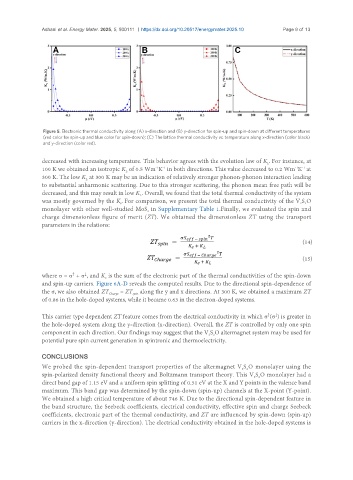
                Figure 5. Electronic thermal conductivity along (A) x-direction and (B) y-direction for spin-up and spin-down at different temperatures
                (red color for spin-up and blue color for spin-down); (C) The lattice thermal conductivity vs. temperature along x-direction (color black)
                and y-direction (color red).

               decreased with increasing temperature. This behavior agrees with the evolution law of K . For instance, at
                                                                                           L
                                                                                                       -1
                                                                                                    -1
                                                        -1
                                                     -1
               100 K we obtained an isotropic K  of 0.5 Wm K  in both directions. This value decreased to 0.2 Wm K  at
                                           L
               300 K. The low K  at 300 K may be an indication of relatively stronger phonon-phonon interaction leading
                              L
               to substantial anharmonic scattering. Due to this stronger scattering, the phonon mean free path will be
               decreased, and this may result in low K . Overall, we found that the total thermal conductivity of the system
                                                L
               was mostly governed by the K . For comparison, we present the total thermal conductivity of the V S O
                                          e
                                                                                                      2 2
               monolayer with other well-studied MoS  in Supplementary Table 1.Finally, we evaluated the spin and
                                                   2
               charge dimensionless figure of merit (ZT). We obtained the dimensionless ZT using the transport
               parameters in the relations:
                                                                                                       (14)
                                                                                                       (15)

               where σ = σ  + σ , and K  is the sum of the electronic part of the thermal conductivities of the spin-down
                         ↑
                              ↓
                                    e
               and spin-up carriers. Figure 6A-D reveals the computed results. Due to the directional spin-dependence of
               the σ, we also obtained ZT Charge  = ZT  along the y and x directions. At 300 K, we obtained a maximum ZT
                                              spin
               of 0.86 in the hole-doped systems, while it became 0.63 in the electron-doped systems.
               This carrier type dependent ZT feature comes from the electrical conductivity in which σ (σ ) is greater in
                                                                                           ↑
                                                                                              ↓
               the hole-doped system along the y-direction (x-direction). Overall, the ZT is controlled by only one spin
               component in each direction. Our findings may suggest that the V S O altermagnet system may be used for
                                                                       2 2
               potential pure spin current generation in spintronic and thermoelectricity.
               CONCLUSIONS
               We probed the spin-dependent transport properties of the altermagnet V S O monolayer using the
                                                                                   2 2
               spin-polarized density functional theory and Boltzmann transport theory. This V S O monolayer had a
                                                                                       2 2
               direct band gap of 1.15 eV and a uniform spin splitting of 0.51 eV at the X and Y points in the valence band
               maximum. This band gap was determined by the spin-down (spin-up) channels at the X-point (Y-point).
               We obtained a high critical temperature of about 746 K. Due to the directional spin-dependent feature in
               the band structure, the Seebeck coefficients, electrical conductivity, effective spin and charge Seebeck
               coefficients, electronic part of the thermal conductivity, and ZT are influenced by spin-down (spin-up)
               carriers in the x-direction (y-direction). The electrical conductivity obtained in the hole-doped systems is

