


Page 67 - Read Online
P. 67
Page 12 of 16                                               Dong et al. Energy Mater.  2026, 6, 600026


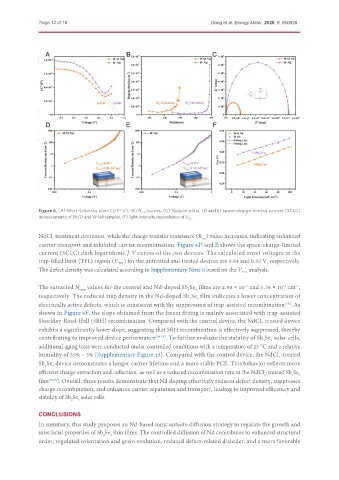
               Figure 6. (A) Mott-Schottky plots (1/C -V), (B) N C-V  curves, (C) Nyquist plots, (D and E) space-charge-limited current (SCLC)
                                           2
               measurements of W/O and W Nd samples, (F) light-intensity dependence of V OC .

               NdCl  treatment decreases, while the charge transfer resistance (R ) value increases, indicating enhanced
                   3
                                                                        rec
               carrier transport and inhibited carrier recombination. Figure 6D and E shows the space-charge-limited
               current (SCLC) dark logarithmic J-V curves of the two devices. The calculated onset voltages in the
               trap-filled limit (TFL) region (V ) for the untreated and treated devices are 0.54 and 0.32 V, respectively.
                                          TFL
               The defect density was calculated according to Supplementary Note 6 based on the V  analysis.
                                                                                      TFL

               The extracted N  values for the control and Nd-doped Sb Se  films are 2.98 × 10  and 1.76 × 10  cm ,
                                                                                                         -3
                                                                                       14
                                                                                                    14
                             trap
                                                                   2
                                                                      3
               respectively. The reduced trap density in the Nd-doped Sb Se  film indicates a lower concentration of
                                                                      3
                                                                    2
               electrically active defects, which is consistent with the suppression of trap-assisted recombination . As
                                                                                                     [53]
               shown in Figure 6F, the slope obtained from the linear fitting is mainly associated with trap-assisted
               Shockley-Read-Hall (SRH) recombination. Compared with the control device, the NdCl -treated device
                                                                                             3
               exhibits a significantly lower slope, suggesting that SRH recombination is effectively suppressed, thereby
               contributing to improved device performance [54,55] . To further evaluate the stability of Sb Se  solar cells,
                                                                                             2
                                                                                                3
               additional aging tests were conducted under controlled conditions with a temperature of 25 °C and a relative
               humidity of 35% ± 5% [Supplementary Figure 13]. Compared with the control device, the NdCl -treated
                                                                                                   3
               Sb Se  device demonstrates a longer carrier lifetime and a more stable PCE. This behavior reflects more
                   3
                 2
               efficient charge extraction and collection, as well as a reduced recombination rate in the NdCl -treated Sb Se 3
                                                                                                       2
                                                                                              3
               film [56,57] . Overall, these results demonstrate that Nd doping effectively reduces defect density, suppresses
               charge recombination, and enhances carrier separation and transport, leading to improved efficiency and
               stability of Sb Se  solar cells.
                            3
                          2
               CONCLUSIONS
               In summary, this study proposes an Nd-based ionic antisite diffusion strategy to regulate the growth and
               interfacial properties of Sb Se  thin films. The controlled diffusion of Nd contributes to enhanced structural
                                        3
                                     2
               order, regulated orientation and grain evolution, reduced defect-related disorder, and a more favorable

