


Page 72 - Read Online
P. 72
Article  |  Open Access

                                                  Energy Materials


                                           Xia et al. Energy Mater. 2026, 6, 600022      DOI:10.20517/energymater.2025.225


               Zn doping modulation of carrier transport properties
               at the back interface of antimony sulfide solar cells


               Ying-Sen Xia 1  , Jun-Cai Zhang , Jie Huang , Jin-Rui Cai , Ling-Jie Liu , Gan Huang , Li-Mei Lin , Zhi-Ping
                                                                                                1,*
                                          1
                                                                                      1
                                                    1
                                                               1
                                                                           1
               Huang , Hu Li , Shuiyuan Chen 1,2,* , Gui-Lin Chen 1,2,*
                    1
                          1,*
               Keywords:
               Sb 2 S 3  solar cells, Zn doping,
               interface engineering, carrier
               transport
               Citation: Xia, Y. S.; Zhang, J.
               C.; Huang, J.; Cai, J. R.; Liu, L.
               J.; Huang, G.; Lin, L. M.;
               Huang, Z. P.; Li, H.; Chen, S.;
               Chen, G. L. Zn doping
               modulation of carrier
               transport properties at the
               back interface of antimony
               sulfide solar cells. Energy
               Mater. 2026, 6, 600022.
               https://dx.doi.org/10.20517
               /energymater.2025.225
               Received: 24 Dec 2025  Abstract
               Accepted: 29 Jan 2026
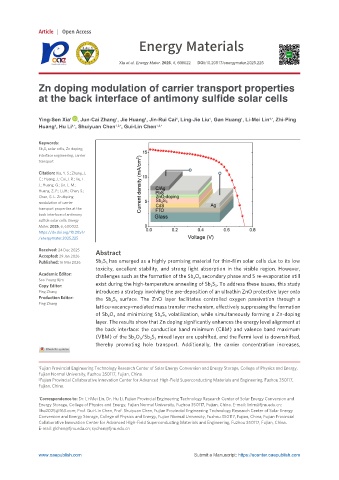
               Published: 16 Mar 2026  Sb 2 S 3  has emerged as a highly promising material for thin-film solar cells due to its low
                                   toxicity,   excellent   stability,   and   strong   light   absorption   in   the   visible   region.   However,
               Academic Editor:    challenges such as the formation of the Sb 2 O 3  secondary phase and S re-evaporation still
               Soo Young Kim
               Copy Editor:        exist during the high-temperature annealing of Sb 2 S 3 . To address these issues, this study
               Ping Zhang          introduces a strategy involving the pre-deposition of an ultrathin ZnO protective layer onto
               Production Editor:  the   Sb 2 S 3   surface.   The   ZnO   layer   facilitates   controlled   oxygen   passivation   through   a
               Ping Zhang
                                   lattice-vacancy-mediated mass transfer mechanism, effectively suppressing the formation
                                   of  Sb 2 O 3   and  minimizing  Sb 2 S 3   volatilization,  while  simultaneously  forming  a  Zn-doping
                                   layer. The results show that Zn doping significantly enhances the energy level alignment at
                                   the  back  interface:  the  conduction  band  minimum  (CBM)  and  valence  band  maximum
                                   (VBM) of the Sb 2 O 3 /Sb 2 S 3  mixed layer are upshifted, and the Fermi level is downshifted,
                                   thereby   promoting   hole   transport.   Additionally,   the   carrier   concentration   increases,


               1 Fujian Provincial Engineering Technology Research Center of Solar Energy Conversion and Energy Storage, College of Physics and Energy,
               Fujian Normal University, Fuzhou 350117, Fujian, China.
               2 Fujian Provincial Collaborative Innovation Center for Advanced High-Field Superconducting Materials and Engineering, Fuzhou 350117,
               Fujian, China.

               * Correspondence to: Dr. Li-Mei Lin, Dr. Hu Li, Fujian Provincial Engineering Technology Research Center of Solar Energy Conversion and
               Energy Storage, College of Physics and Energy, Fujian Normal University, Fuzhou 350117, Fujian, China. E-mail: linlm@fjnu.edu.cn;
               lihu2025@163.com; Prof. Gui-Lin Chen, Prof. Shuiyuan Chen, Fujian Provincial Engineering Technology Research Center of Solar Energy
               Conversion and Energy Storage, College of Physics and Energy, Fujian Normal University, Fuzhou 350117, Fujian, China; Fujian Provincial
               Collaborative Innovation Center for Advanced High-Field Superconducting Materials and Engineering, Fuzhou 350117, Fujian, China.
               E-mail: glchen@fjnu.edu.cn; sychen@fjnu.edu.cn


               www.oaepublish.com                                    Submit a Manuscript: https://ucenter.oaepublish.com

