


Page 33 - 2417
P. 33
Chaib et al. Carbon Footprints 2026, 5, 23                                        Page 9 of 23


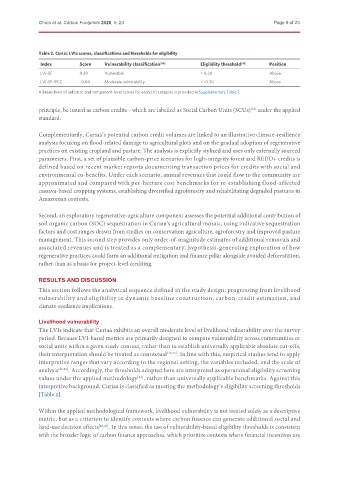
               Table 2. Curiaú LVIs scores, classifications and thresholds for eligibility
               Index         Score    Vulnerability classification [50]  Eligibility threshold [43]  Position

               LVI-SF        0.39     Vulnerable                       > 0.30                   Above
               LVI-SF-IPCC   -0.04    Moderate vulnerability           > -0.30                  Above

               A breakdown of indicator and component-level scores for each LVI category is provided in Supplementary Table 1.

               principle, be issued as carbon credits - which are labelled as Social Carbon Units (SCUs)  under the applied
                                                                                         [52]
               standard.

               Complementarily, Curiaú’s potential carbon credit volumes are linked to an illustrative climate-resilience
               analysis focusing on flood-related damage to agricultural plots and on the gradual adoption of regenerative
               practices on existing cropland and pasture. The analysis is explicitly stylized and uses only externally sourced
               parameters. First, a set of plausible carbon-price scenarios for high-integrity forest and REDD+ credits is
               defined based on recent market reports documenting transaction prices for credits with social and
               environmental co-benefits. Under each scenario, annual revenues that could flow to the community are
               approximated and compared with per-hectare cost benchmarks for re-establishing flood-affected
               cassava-based cropping systems, establishing diversified agroforestry and rehabilitating degraded pastures in
               Amazonian contexts.


               Second, an exploratory regenerative-agriculture component assesses the potential additional contribution of
               soil organic carbon (SOC) sequestration in Curiaú’s agricultural mosaic, using indicative sequestration
               factors and cost ranges drawn from studies on conservation agriculture, agroforestry and improved pasture
               management. This second step provides only order-of-magnitude estimates of additional removals and
               associated revenues and is treated as a complementary, hypothesis-generating exploration of how
               regenerative practices could form an additional mitigation and finance pillar alongside avoided deforestation,
               rather than as a basis for project-level crediting.

               RESULTS AND DISCUSSION
               This section follows the analytical sequence defined in the study design, progressing from livelihood
               vulnerability and eligibility to dynamic baseline construction, carbon-credit estimation, and
               climate-resilience implications.


               Livelihood vulnerability
               The LVIs indicate that Curiaú exhibits an overall moderate level of livelihood vulnerability over the survey
               period. Because LVI-based metrics are primarily designed to compare vulnerability across communities or
               social units within a given study context, rather than to establish universally applicable absolute cut-offs,
               their interpretation should be treated as contextual [45,50] . In line with this, empirical studies tend to apply
               interpretive ranges that vary according to the regional setting, the variables included, and the scale of
               analysis [45,50] . Accordingly, the thresholds adopted here are interpreted as operational eligibility screening
               values under the applied methodology , rather than universally applicable benchmarks. Against this
                                                 [43]
               interpretive background, Curiaú is classified as meeting the methodology’s eligibility screening thresholds
               [Table 2].


               Within the applied methodological framework, livelihood vulnerability is not treated solely as a descriptive
               metric, but as a criterion to identify contexts where carbon finance can generate additional social and
               land-use decision effects [42,43] . In this sense, the use of vulnerability-based eligibility thresholds is consistent
               with the broader logic of carbon finance approaches, which prioritize contexts where financial incentives are

