


Page 38 - 2417
P. 38
Page 14 of 23                                                 Chaib et al. Carbon Footprints 2026, 5, 23


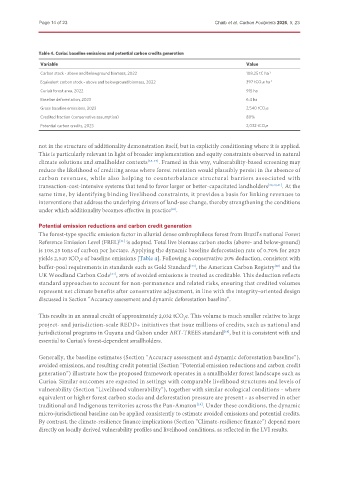
               Table 4. Curiaú baseline emissions and potential carbon credits generation
               Variable                                                                Value

               Carbon stock - above and belowground biomass, 2022                      108.25 tC ha -1
               Equivalent carbon stock - above and belowground biomass, 2022           397 tCO 2 e ha -1
               Curiaú forest area, 2022                                                915 ha
               Baseline deforestation, 2023                                            6.4 ha
               Gross baseline emissions, 2023                                          2,540 tCO 2 e
               Credited fraction (conservative assumption)                             80%
               Potential carbon credits, 2023                                          2,032 tCO 2 e


               not in the structure of additionality demonstration itself, but in explicitly conditioning where it is applied.
               This is particularly relevant in light of broader implementation and equity constraints observed in natural
               climate solutions and smallholder contexts [35-37] . Framed in this way, vulnerability-based screening may
               reduce the likelihood of crediting areas where forest retention would plausibly persist in the absence of
               carbon revenues, while also helping to counterbalance structural barriers associated with
               transaction-cost-intensive systems that tend to favor larger or better-capacitated landholders [38,39,41] . At the
               same time, by identifying binding livelihood constraints, it provides a basis for linking revenues to
               interventions that address the underlying drivers of land-use change, thereby strengthening the conditions
               under which additionality becomes effective in practice .
                                                             [65]

               Potential emission reductions and carbon credit generation
               The forest-type specific emission factor in alluvial dense ombrophilous forest from Brazil’s national Forest
               Reference Emission Level (FREL)  is adopted. Total live biomass carbon stocks (above- and below-ground)
                                           [51]
               is 108.25 tons of carbon per hectare. Applying the dynamic baseline deforestation rate of 0.70% for 2023
               yields 2,540 tCO e of baseline emissions [Table 4]. Following a conservative 20% deduction, consistent with
                             2
               buffer-pool requirements in standards such as Gold Standard , the American Carbon Registry  and the
                                                                                                 [66]
                                                                    [33]
               UK Woodland Carbon Code , 80% of avoided emissions is treated as creditable. This deduction reflects
                                        [67]
               standard approaches to account for non-permanence and related risks, ensuring that credited volumes
               represent net climate benefits after conservative adjustment, in line with the integrity-oriented design
               discussed in Section “Accuracy assessment and dynamic deforestation baseline”.

               This results in an annual credit of approximately 2,032 tCO e. This volume is much smaller relative to large
                                                                  2
               project- and jurisdiction-scale REDD+ initiatives that issue millions of credits, such as national and
               jurisdictional programs in Guyana and Gabon under ART-TREES standard , but it is consistent with and
                                                                                [68]
               essential to Curiaú’s forest-dependent smallholders.

               Generally, the baseline estimates (Section “Accuracy assessment and dynamic deforestation baseline”),
               avoided emissions, and resulting credit potential (Section “Potential emission reductions and carbon credit
               generation”) illustrate how the proposed framework operates in a smallholder forest landscape such as
               Curiaú. Similar outcomes are expected in settings with comparable livelihood structures and levels of
               vulnerability (Section “Livelihood vulnerability”), together with similar ecological conditions - where
               equivalent or higher forest carbon stocks and deforestation pressure are present - as observed in other
               traditional and Indigenous territories across the Pan-Amazon . Under these conditions, the dynamic
                                                                      [19]
               micro-jurisdictional baseline can be applied consistently to estimate avoided emissions and potential credits.
               By contrast, the climate-resilience finance implications (Section “Climate-resilience finance”) depend more
               directly on locally derived vulnerability profiles and livelihood conditions, as reflected in the LVI results.

