


Page 39 - 2417
P. 39
Chaib et al. Carbon Footprints 2026, 5, 23                                       Page 15 of 23


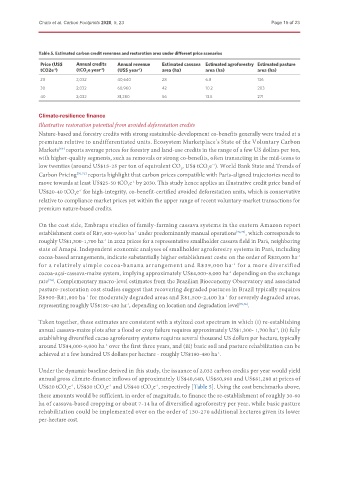
               Table 5. Estimated carbon credit revenues and restoration area under different price scenarios

               Price (US$   Annual credits  Annual revenue  Estimated cassava  Estimated agroforestry Estimated pasture
                                    -1
               tCO2e )      (tCO 2 e year )  (US$ year )  area (ha)      area (ha)         area (ha)
                                                  -1
                    -1
               20           2,032         40,640          28             6.8               136
               30           2,032         60,960          42             10.2              203
               40           2,032         81,280          56             13.5              271


               Climate-resilience finance
               Illustrative restoration potential from avoided deforestation credits
               Nature-based and forestry credits with strong sustainable-development co-benefits generally were traded at a
               premium relative to undifferentiated units. Ecosystem Marketplace’s State of the Voluntary Carbon
               Markets  reports average prices for forestry and land-use credits in the range of a few US dollars per ton,
                      [69]
               with higher-quality segments, such as removals or strong co-benefits, often transacting in the mid-teens to
               low twenties (around US$15-25 per ton of equivalent CO , US$ tCO e ). World Bank State and Trends of
                                                                           -1
                                                                          2
                                                                2
               Carbon Pricing [70,71]  reports highlight that carbon prices compatible with Paris-aligned trajectories need to
               move towards at least US$25-50 tCO e  by 2030. This study hence applies an illustrative credit price band of
                                               -1
                                              2
               US$20-40 tCO e  for high-integrity, co-benefit-certified avoided deforestation units, which is conservative
                             -1
                           2
               relative to compliance market prices yet within the upper range of recent voluntary-market transactions for
               premium nature-based credits.
               On the cost side, Embrapa studies of family-farming cassava systems in the eastern Amazon report
               establishment costs of R$7,400-9,600 ha  under predominantly manual operations [72,73] , which corresponds to
                                                -1
               roughly US$1,300-1,700 ha  in 2022 prices for a representative smallholder cassava field in Pará, neighboring
                                     -1
               state of Amapá. Independent economic analyses of smallholder agroforestry systems in Pará, including
               cocoa-based arrangements, indicate substantially higher establishment costs: on the order of R$20,000 ha -1
               for a relatively simple cocoa-banana arrangement and R$39,000 ha  for a more diversified
                                                                                   -1
               cocoa-açaí-cassava-maize system, implying approximately US$4,000-8,000 ha  depending on the exchange
                                                                                 -1
               rate . Complementary macro-level estimates from the Brazilian Bioeconomy Observatory and associated
                  [74]
               pasture-restoration cost studies suggest that recovering degraded pastures in Brazil typically requires
               R$900-R$1,800 ha  for moderately degraded areas and R$1,500-2,400 ha  for severely degraded areas,
                               -1
                                                                                -1
               representing roughly US$180-480 ha , depending on location and degradation level [75,76] .
                                             -1
               Taken together, these estimates are consistent with a stylized cost spectrum in which (i) re-establishing
               annual cassava-maize plots after a flood or crop failure requires approximately US$1,300- 1,700 ha , (ii) fully
                                                                                                  -1
               establishing diversified cacao agroforestry systems requires several thousand US dollars per hectare, typically
               around US$4,000-8,000 ha  over the first three years, and (iii) basic soil and pasture rehabilitation can be
                                      -1
               achieved at a few hundred US dollars per hectare - roughly US$180-480 ha .
                                                                             -1
               Under the dynamic baseline derived in this study, the issuance of 2,032 carbon credits per year would yield
               annual gross climate-finance inflows of approximately US$40,640, US$60,960 and US$81,280 at prices of
               US$20 tCO e , US$30 tCO e  and US$40 tCO e , respectively [Table 5]. Using the cost benchmarks above,
                          -1
                                                        -1
                                       -1
                        2
                                      2
                                                      2
               these amounts would be sufficient, in order of magnitude, to finance the re-establishment of roughly 30-60
               ha of cassava-based cropping or about 7-14 ha of diversified agroforestry per year, while basic pasture
               rehabilitation could be implemented over on the order of 130-270 additional hectares given its lower
               per-hectare cost.

