


Page 77 - Read online
P. 77
Page 10 of 16                                                  Cui et al. Carbon Footprints 2026, 5, 19


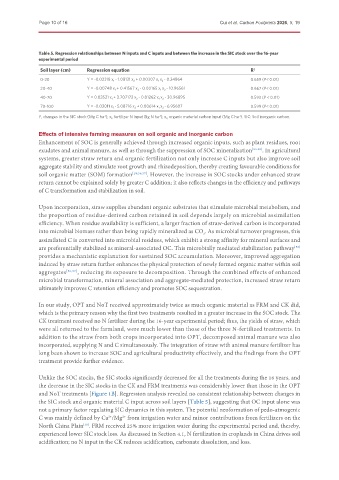
               Table 5. Regression relationships between N inputs and C inputs and between the increase in the SIC stock over the 16-year
               experimental period

               Soil layer (cm)  Regression equation                                      R 2
               0-20             Y = -0.02318 x 1  - 1.08131 x 2  + 0.00307 x 1  x 2  - 0.24864  0.659 (P< 0.01)
               20-40            Y = -0.00748 x 1  + 0.41567 x 2  - 0.00165 x 1  x 2  - 10.96561  0.667 (P< 0.01)
               40-70            Y = 0.03531 x 1  + 3.707172 x 2  - 0.01262 x 1  x 2  - 30.96895  0.593 (P < 0.01)
               70-100           Y = -0.03011 x 1  - 5.08716 x 2  + 0.00614 x 1  x 2  - 6.95607  0.599 (P< 0.01)
               Y, changes in the SIC stock (Mg C ha ); x 1 , fertilizer N input (kg N ha ); x 2,  organic material carbon input (Mg C ha ). SIC: Soil inorganic carbon.
                                                         -1
                                                                                     -1
                                      -1
               Effects of intensive farming measures on soil organic and inorganic carbon
               Enhancement of SOC is generally achieved through increased organic inputs, such as plant residues, root
               exudates and animal manure, as well as through the suppression of SOC mineralization [53-55] . In agricultural
               systems, greater straw return and organic fertilization not only increase C inputs but also improve soil
               aggregate stability and stimulate root growth and rhizodeposition, thereby creating favourable conditions for
               soil organic matter (SOM) formation [18,56,57] . However, the increase in SOC stocks under enhanced straw
               return cannot be explained solely by greater C addition; it also reflects changes in the efficiency and pathways
               of C transformation and stabilization in soil.

               Upon incorporation, straw supplies abundant organic substrates that stimulate microbial metabolism, and
               the proportion of residue-derived carbon retained in soil depends largely on microbial assimilation
               efficiency. When residue availability is sufficient, a larger fraction of straw-derived carbon is incorporated
               into microbial biomass rather than being rapidly mineralized as CO . As microbial turnover progresses, this
                                                                        2
               assimilated C is converted into microbial residues, which exhibit a strong affinity for mineral surfaces and
               are preferentially stabilized as mineral-associated OC. This microbially mediated stabilization pathway [58]
               provides a mechanistic explanation for sustained SOC accumulation. Moreover, improved aggregation
               induced by straw return further enhances the physical protection of newly formed organic matter within soil
               aggregates [56,57] , reducing its exposure to decomposition. Through the combined effects of enhanced
               microbial transformation, mineral association and aggregate-mediated protection, increased straw return
               ultimately improves C retention efficiency and promotes SOC sequestration.


               In our study, OPT and NoT received approximately twice as much organic material as FRM and CK did,
               which is the primary reason why the first two treatments resulted in a greater increase in the SOC stock. The
               CK treatment received no N fertilizer during the 16-year experimental period; thus, the yields of straw, which
               were all returned to the farmland, were much lower than those of the three N-fertilized treatments. In
               addition to the straw from both crops incorporated into OPT, decomposed animal manure was also
               incorporated, supplying N and C simultaneously. The integration of straw with animal manure fertilizer has
               long been shown to increase SOC and agricultural productivity effectively, and the findings from the OPT
               treatment provide further evidence.


               Unlike the SOC stocks, the SIC stocks significantly decreased for all the treatments during the 16 years, and
               the decrease in the SIC stocks in the CK and FRM treatments was considerably lower than those in the OPT
               and NoT treatments [Figure 1B]. Regression analysis revealed no consistent relationship between changes in
               the SIC stock and organic material C input across soil layers [Table 5], suggesting that OC input alone was
               not a primary factor regulating SIC dynamics in this system. The potential neoformation of pedo-atmogenic
               C was mainly defined by Ca /Mg  from irrigation water and minor contributions from fertilizers on the
                                            2+
                                       2+
               North China Plain . FRM received 25% more irrigation water during the experimental period and, thereby,
                              [10]
               experienced lower SIC stock loss. As discussed in Section 4.1, N fertilization in croplands in China drives soil
               acidification; no N input in the CK reduces acidification, carbonate dissolution, and loss.

