


Page 78 - Read online
P. 78
Cui et al. Carbon Footprints 2026, 5, 19                                         Page 11 of 16


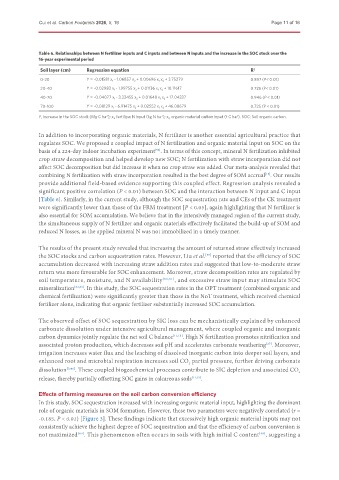
               Table 6. Relationships between N fertilizer inputs and C inputs and between N inputs and the increase in the SOC stock over the
               16-year experimental period

               Soil layer (cm)  Regression equation                                      R 2
               0-20            Y = -0.01581 x 1  - 1.06857 x 2  + 0.00696 x 1  x 2  + 3.75279  0.897 (P< 0.01)
               20-40           Y = -0.02983 x 1  - 1.99755 x 2  + 0.01136 x 1  x 2  + 10.11617  0.725 (P< 0.01)
               40-70           Y = -0.04077 x 1  - 3.23455 x 2  + 0.01648 x 1  x 2  + 17.04337  0.946 (P < 0.01)
               70-100          Y = -0.08129 x 1  - 6.91475 x 2  + 0.02552 x 1  x 2  + 46.08679  0.725 (P < 0.01)
               Y, increase in the SOC stock (Mg C ha ); x 1 , fertilizer N input (kg N ha ); x 2,  organic material carbon input (t C ha ). SOC: Soil organic carbon.
                                      -1
                                                                                    -1
                                                          -1
               In addition to incorporating organic materials, N fertilizer is another essential agricultural practice that
               regulates SOC. We proposed a coupled impact of N fertilization and organic material input on SOC on the
               basis of a 224-day indoor incubation experiment . In terms of this concept, mineral N fertilization inhibited
                                                       [58]
               crop straw decomposition and helped develop new SOC; N fertilization with straw incorporation did not
               affect SOC decomposition but did increase it when no crop straw was added. Our meta-analysis revealed that
               combining N fertilization with straw incorporation resulted in the best degree of SOM accrual . Our results
                                                                                              [15]
               provide additional field-based evidence supporting this coupled effect. Regression analysis revealed a
               significant positive correlation (P < 0.01) between SOC and the interaction between N input and C input
               [Table 6]. Similarly, in the current study, although the SOC sequestration rate and CEs of the CK treatment
               were significantly lower than those of the FRM treatment [P < 0.05], again highlighting that N fertilizer is
               also essential for SOM accumulation. We believe that in the intensively managed region of the current study,
               the simultaneous supply of N fertilizer and organic materials effectively facilitated the build-up of SOM and
               reduced N losses, as the applied mineral N was not immobilized in a timely manner.

               The results of the present study revealed that increasing the amount of returned straw effectively increased
               the SOC stocks and carbon sequestration rates. However, Liu et al.  reported that the efficiency of SOC
                                                                         [59]
               accumulation decreased with increasing straw addition rates and suggested that low-to-moderate straw
               return was more favourable for SOC enhancement. Moreover, straw decomposition rates are regulated by
               soil temperature, moisture, and N availability [60,61] , and excessive straw input may stimulate SOC
               mineralization [62,63] . In this study, the SOC sequestration rates in the OPT treatment (combined organic and
               chemical fertilization) were significantly greater than those in the NoT treatment, which received chemical
               fertilizer alone, indicating that organic fertilizer substantially increased SOC accumulation.

               The observed offset of SOC sequestration by SIC loss can be mechanistically explained by enhanced
               carbonate dissolution under intensive agricultural management, where coupled organic and inorganic
               carbon dynamics jointly regulate the net soil C balance [11,13] . High N fertilization promotes nitrification and
               associated proton production, which decreases soil pH and accelerates carbonate weathering . Moreover,
                                                                                              [27]
               irrigation increases water flux and the leaching of dissolved inorganic carbon into deeper soil layers, and
               enhanced root and microbial respiration increases soil CO  partial pressure, further driving carbonate
                                                                   2
               dissolution [3,46] . These coupled biogeochemical processes contribute to SIC depletion and associated CO 2
               release, thereby partially offsetting SOC gains in calcareous soils [11,13] .


               Effects of farming measures on the soil carbon conversion efficiency
               In this study, SOC sequestration increased with increasing organic material input, highlighting the dominant
               role of organic materials in SOM formation. However, these two parameters were negatively correlated (r =
               -0.185, P < 0.01) [Figure 3]. These findings indicate that excessively high organic material inputs may not
               consistently achieve the highest degree of SOC sequestration and that the efficiency of carbon conversion is
               not maximized . This phenomenon often occurs in soils with high initial C content , suggesting a
                                                                                            [48]
                            [64]

