


Page 88 - Read Online
P. 88
Page 10 of 18                   Shang et al. Carbon Footprints 2025, 4, 24  https://dx.doi.org/10.20517/cf.2025.28


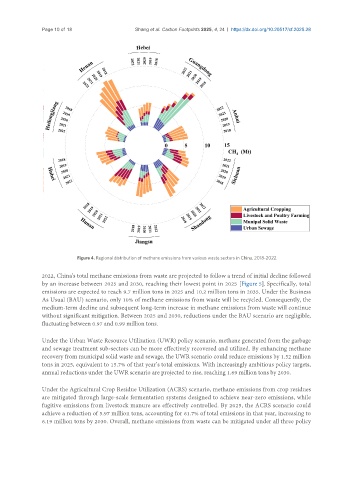
                           Figure 4. Regional distribution of methane emissions from various waste sectors in China, 2018-2022.

               2022, China's total methane emissions from waste are projected to follow a trend of initial decline followed
               by an increase between 2025 and 2030, reaching their lowest point in 2025 [Figure 5]. Specifically, total
               emissions are expected to reach 9.7 million tons in 2025 and 10.2 million tons in 2035. Under the Business
               As Usual (BAU) scenario, only 10% of methane emissions from waste will be recycled. Consequently, the
               medium-term decline and subsequent long-term increase in methane emissions from waste will continue
               without significant mitigation. Between 2025 and 2030, reductions under the BAU scenario are negligible,
               fluctuating between 0.97 and 0.99 million tons.


               Under the Urban Waste Resource Utilization (UWR) policy scenario, methane generated from the garbage
               and sewage treatment sub-sectors can be more effectively recovered and utilized. By enhancing methane
               recovery from municipal solid waste and sewage, the UWR scenario could reduce emissions by 1.52 million
               tons in 2025, equivalent to 15.7% of that year’s total emissions. With increasingly ambitious policy targets,
               annual reductions under the UWR scenario are projected to rise, reaching 1.69 million tons by 2030.

               Under the Agricultural Crop Residue Utilization (ACRS) scenario, methane emissions from crop residues
               are mitigated through large-scale fermentation systems designed to achieve near-zero emissions, while
               fugitive emissions from livestock manure are effectively controlled. By 2025, the ACRS scenario could
               achieve a reduction of 5.97 million tons, accounting for 61.7% of total emissions in that year, increasing to
               6.19 million tons by 2030. Overall, methane emissions from waste can be mitigated under all three policy

