


Page 89 - Read Online
P. 89
Shang et al. Carbon Footprints 2025, 4, 24  https://dx.doi.org/10.20517/cf.2025.28  Page 11 of 18


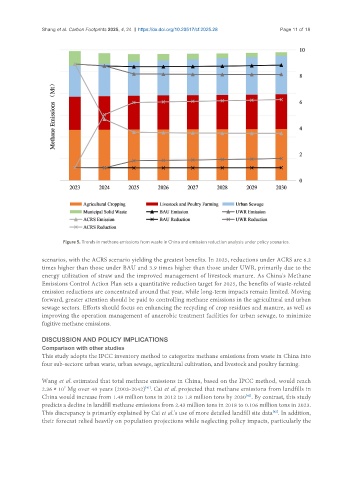
                      Figure 5. Trends in methane emissions from waste in China and emission reduction analysis under policy scenarios.


               scenarios, with the ACRS scenario yielding the greatest benefits. In 2025, reductions under ACRS are 6.2
               times higher than those under BAU and 3.9 times higher than those under UWR, primarily due to the
               energy utilization of straw and the improved management of livestock manure. As China's Methane
               Emissions Control Action Plan sets a quantitative reduction target for 2025, the benefits of waste-related
               emission reductions are concentrated around that year, while long-term impacts remain limited. Moving
               forward, greater attention should be paid to controlling methane emissions in the agricultural and urban
               sewage sectors. Efforts should focus on enhancing the recycling of crop residues and manure, as well as
               improving the operation management of anaerobic treatment facilities for urban sewage, to minimize
               fugitive methane emissions.


               DISCUSSION AND POLICY IMPLICATIONS
               Comparison with other studies
               This study adopts the IPCC inventory method to categorize methane emissions from waste in China into
               four sub-sectors: urban waste, urban sewage, agricultural cultivation, and livestock and poultry farming.

               Wang et al. estimated that total methane emissions in China, based on the IPCC method, would reach
               2.36 × 10  Mg over 40 years (2003-2042) . Cai et al. projected that methane emissions from landfills in
                                                  [41]
                       7
               China would increase from 1.48 million tons in 2012 to 1.8 million tons by 2030 . By contrast, this study
                                                                                    [42]
               predicts a decline in landfill methane emissions from 2.43 million tons in 2018 to 0.106 million tons in 2023.
               This discrepancy is primarily explained by Cai et al.'s use of more detailed landfill site data . In addition,
                                                                                             [42]
               their forecast relied heavily on population projections while neglecting policy impacts, particularly the

