


Page 85 - Read Online
P. 85
Shang et al. Carbon Footprints 2025, 4, 24  https://dx.doi.org/10.20517/cf.2025.28  Page 7 of 18


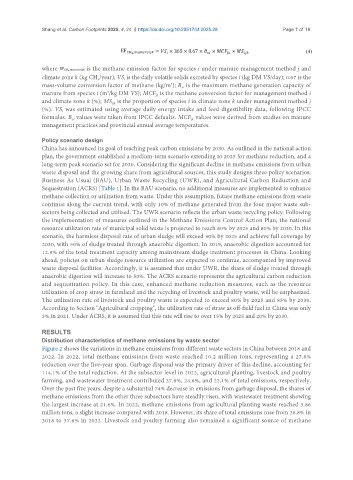
               where           is the methane emission factor for species i under manure management method j and
               climate zone k (kg CH /year); VS is the daily volatile solids excreted by species i (kg DM VS/day); 0.67 is the
                                  4
                                           i
               mass-volume conversion factor of methane (kg/m ); B  is the maximum methane generation capacity of
                                                           3
                                                              oi
               manure from species i (m /kg DM VS); MCF  is the methane conversion factor for management method i
                                     3
                                                     jk
               and climate zone k (%); MS  is the proportion of species i in climate zone k under management method j
                                       ijk
               (%). VS  was estimated using average daily energy intake and feed digestibility data, following IPCC
                      i
               formulas. B  values were taken from IPCC defaults. MCF  values were derived from studies on manure
                                                                 jk
                         oi
               management practices and provincial annual average temperatures.
               Policy scenario design
               China has announced its goal of reaching peak carbon emissions by 2030. As outlined in the national action
               plan, the government established a medium-term scenario extending to 2025 for methane reduction, and a
               long-term peak scenario set for 2030. Considering the significant decline in methane emissions from urban
               waste disposal and the growing share from agricultural sources, this study designs three policy scenarios:
               Business As Usual (BAU), Urban Waste Recycling (UWR), and Agricultural Carbon Reduction and
               Sequestration (ACRS) [Table 1]. In the BAU scenario, no additional measures are implemented to enhance
               methane collection or utilization from waste. Under this assumption, future methane emissions from waste
               continue along the current trend, with only 10% of methane generated from the four major waste sub-
               sectors being collected and utilized. The UWR scenario reflects the urban waste recycling policy. Following
               the implementation of measures outlined in the Methane Emissions Control Action Plan, the national
               resource utilization rate of municipal solid waste is projected to reach 60% by 2025 and 80% by 2030. In this
               scenario, the harmless disposal rate of urban sludge will exceed 90% by 2025 and achieve full coverage by
               2030, with 50% of sludge treated through anaerobic digestion. In 2019, anaerobic digestion accounted for
               12.9% of the total treatment capacity among mainstream sludge treatment processes in China. Looking
               ahead, policies on urban sludge resource utilization are expected to continue, accompanied by improved
               waste disposal facilities. Accordingly, it is assumed that under UWR, the share of sludge treated through
               anaerobic digestion will increase to 50%. The ACRS scenario represents the agricultural carbon reduction
               and sequestration policy. In this case, enhanced methane reduction measures, such as the resource
               utilization of crop straw in farmland and the recycling of livestock and poultry waste, will be emphasized.
               The utilization rate of livestock and poultry waste is expected to exceed 80% by 2025 and 85% by 2030.
               According to Section "Agricultural cropping", the utilization rate of straw as off-field fuel in China was only
               3% in 2021. Under ACRS, it is assumed that this rate will rise to over 15% by 2025 and 20% by 2030.

               RESULTS
               Distribution characteristics of methane emissions by waste sector
               Figure 2 shows the variations in methane emissions from different waste sectors in China between 2018 and
               2022. In 2022, total methane emissions from waste reached 10.2 million tons, representing a 27.8%
               reduction over the five-year span. Garbage disposal was the primary driver of this decline, accounting for
               114.1% of the total reduction. At the subsector level in 2022, agricultural planting, livestock and poultry
               farming, and wastewater treatment contributed 37.8%, 24.6%, and 22.1% of total emissions, respectively.
               Over the past five years, despite a substantial 74% decrease in emissions from garbage disposal, the shares of
               methane emissions from the other three subsectors have steadily risen, with wastewater treatment showing
               the largest increase at 21.6%. In 2022, methane emissions from agricultural planting waste reached 3.86
               million tons, a slight increase compared with 2018. However, its share of total emissions rose from 26.8% in
               2018 to 37.8% in 2022. Livestock and poultry farming also remained a significant source of methane

