


Page 83 - Read Online
P. 83
Shang et al. Carbon Footprints 2025, 4, 24  https://dx.doi.org/10.20517/cf.2025.28  Page 5 of 18


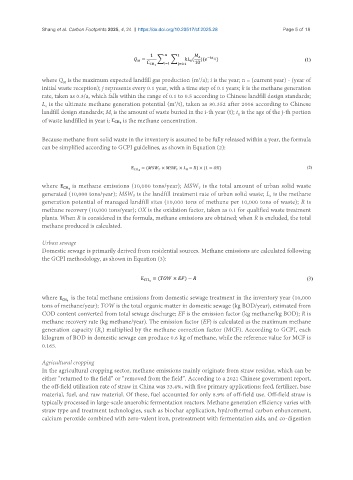
               where Q  is the maximum expected landfill gas production (m /a); i is the year; n = (current year) - (year of
                                                                    3
                      M
               initial waste reception); j represents every 0.1 year, with a time step of 0.1 years; k is the methane generation
               rate, taken as 0.3/a, which falls within the range of 0.1 to 0.5 according to Chinese landfill design standards;
               L  is the ultimate methane generation potential (m /t), taken as 80.352 after 2006 according to Chinese
                                                            3
                0
               landfill design standards; M is the amount of waste buried in the i-th year (t); t  is the age of the j-th portion
                                                                                 ij
                                      i
               of waste landfilled in year i;    is the methane concentration.
               Because methane from solid waste in the inventory is assumed to be fully released within a year, the formula
               can be simplified according to GCPI guidelines, as shown in Equation (2):


               where      is methane emissions (10,000 tons/year); MSW  is the total amount of urban solid waste
                                                                    T
               generated (10,000 tons/year); MSW  is the landfill treatment rate of urban solid waste; L  is the methane
                                                                                            0
                                              F
               generation potential of managed landfill sites (10,000 tons of methane per 10,000 tons of waste); R is
               methane recovery (10,000 tons/year); OX is the oxidation factor, taken as 0.1 for qualified waste treatment
               plants. When R is considered in the formula, methane emissions are obtained; when R is excluded, the total
               methane produced is calculated.

               Urban sewage
               Domestic sewage is primarily derived from residential sources. Methane emissions are calculated following
               the GCPI methodology, as shown in Equation (3):


               where     is the total methane emissions from domestic sewage treatment in the inventory year (10,000
               tons of methane/year); TOW is the total organic matter in domestic sewage (kg BOD/year), estimated from
               COD content converted from total sewage discharge; EF is the emission factor (kg methane/kg BOD); R is
               methane recovery rate (kg methane/year). The emission factor (EF) is calculated as the maximum methane
               generation capacity (B ) multiplied by the methane correction factor (MCF). According to GCPI, each
                                   0
               kilogram of BOD in domestic sewage can produce 0.6 kg of methane, while the reference value for MCF is
               0.165.


               Agricultural cropping
               In the agricultural cropping sector, methane emissions mainly originate from straw residue, which can be
               either “returned to the field” or “removed from the field”. According to a 2021 Chinese government report,
               the off-field utilization rate of straw in China was 33.4%, with five primary applications: feed, fertilizer, base
               material, fuel, and raw material. Of these, fuel accounted for only 8.9% of off-field use. Off-field straw is
               typically processed in large-scale anaerobic fermentation reactors. Methane generation efficiency varies with
               straw type and treatment technologies, such as biochar application, hydrothermal carbon enhancement,
               calcium peroxide combined with zero-valent iron, pretreatment with fermentation aids, and co-digestion

