


Page 31 - Read Online
P. 31
Page 10 of 21                   Özbek et al. Carbon Footprints 2025, 4, 30  https://dx.doi.org/10.20517/cf.2025.43

               The significant result of the F  test indicates that the lagged levels of the dependent variable and the
                                          OV
               independent variables are integrated. However, the significant result of the F  test may indicate that only
                                                                                 OV
               the lagged state of the dependent variable is significant or only the lagged states of the independent variables
               are significant together. Accordingly, if only t  is significant, the ARDL equation becomes the ADF
                                                         DV
               regression equation, and in this case, the dependent variable becomes I(0).

               McNown et al.  proposed an additional robustness test based on the significance of the lagged
                            [63]
               independent variables as a whole (F ) instead of the assumption that the dependent variable is I(1). The
                                              IV
               main advantage of the additional test is that it relaxes the condition that the dependent variable is I(1) to
               exclude the degenerate case.


               In order to make a cointegration inference in the A-ARDL model, the F  and t  tests suggested by
                                                                                OV
                                                                                        DV
                                                                 [63]
                          [64]
               Pesaran et al.  and the F  test suggested by McNown et al.  must be significant together. If the F  and t
                                    IV
                                                                                                        DV
                                                                                                  OV
               tests are significant while the F  test is insignificant, then there is degeneration of the lagged states of the
                                          IV
               independent variables. On the other hand, if the F  ve F  tests are significant while the t  test is
                                                                    IV
                                                                                                  DV
                                                              OV
               insignificant, then the degeneration of the lagged state of the dependent variable is valid . If one of these
                                                                                           [65]
               two situations occurs, cointegration inference cannot be made. All three tests must be significant at the
               same time for cointegration.
                           [63]
               Mcnown et al.  proposed a critical value calculation method based on the bootstrap process for the F  test,
                                                                                                     IV
               which they proposed to test the joint significance of the lagged states of the independent variables. However,
                                                                           [65]
               since this method was problematic in terms of application, Sam et al.  created the critical value table by
               proving the basic theorems and making the necessary calculations.
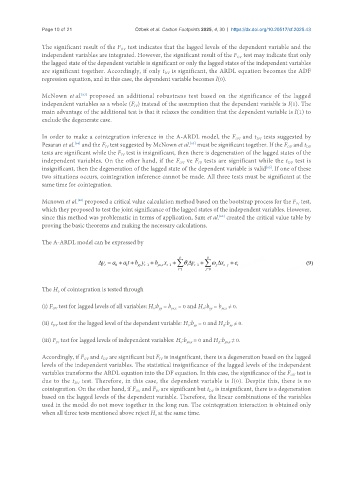
               The A-ARDL model can be expressed by


               The H  of cointegration is tested through
                     0

               (i) F  test for lagged levels of all variables: H :b  = b  = 0 and H :b  = b  ≠ 0.
                                                                            yx,x
                                                     0
                                                                        yy
                                                       yy
                   OV
                                                                     A
                                                           yx,x
               (ii) t  test for the lagged level of the dependent variable: H :b  = 0 and H :b  ≠ 0.
                                                                  yy
                   DV
                                                                              yy
                                                                0
                                                                            A
               (iii) F  test for lagged levels of independent variables: H :b  = 0 and H :b  ≠ 0.
                                                                             yx,x
                                                                           A
                    IV
                                                              0
                                                                yx,x
               Accordingly, if F  and t  are significant but F  is insignificant, there is a degeneration based on the lagged
                             OV
                                                       IV
                                    DV
               levels of the independent variables. The statistical insignificance of the lagged levels of the independent
               variables transforms the ARDL equation into the DF equation. In this case, the significance of the F  test is
                                                                                                   OV
               due to the t  test. Therefore, in this case, the dependent variable is I(0). Despite this, there is no
                          DV
               cointegration. On the other hand, if F  and F  are significant but t  is insignificant, there is a degeneration
                                                                       DV
                                                      IV
                                               OV
               based on the lagged levels of the dependent variable. Therefore, the linear combinations of the variables
               used in the model do not move together in the long run. The cointegration interaction is obtained only
               when all three tests mentioned above reject H  at the same time.
                                                     0

