


Page 30 - Read Online
P. 30
Özbek et al. Carbon Footprints 2025, 4, 30  https://dx.doi.org/10.20517/cf.2025.43  Page 9 of 21


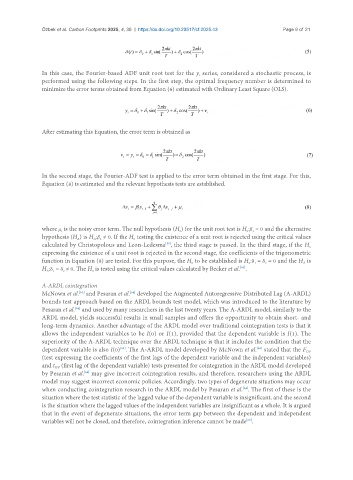
               In this case, the Fourier-based ADF unit root test for the y  series, considered a stochastic process, is
                                                                    t
               performed using the following steps. In the first step, the optimal frequency number is determined to
               minimize the error terms obtained from Equation (6) estimated with Ordinary Least Square (OLS).


               After estimating this Equation, the error term is obtained as


               In the second stage, the Fourier-ADF test is applied to the error term obtained in the first stage. For this,
               Equation (8) is estimated and the relevant hypothesis tests are established.


               where μ is the noisy error term. The null hypothesis (H ) for the unit root test is H :β  = 0 and the alternative
                                                                                    0 1
                      t
                                                              0
               hypothesis (H ) is H :β  ≠ 0. If the H  testing the existence of a unit root is rejected using the critical values
                                   1
                                              0
                           A
                                 A
               calculated by Christopolous and Leon-Ledesma , the third stage is passed. In the third stage, if the H
                                                         [58]
                                                                                                         0
               expressing the existence of a unit root is rejected in the second stage, the coefficients of the trigonometric
               function in Equation (8) are tested. For this purpose, the H  to be established is H :δ  = δ  = 0 and the H  is
                                                                                     0 1
                                                                                          2
                                                                  0
                                                                                                       A
                                                                                  [60]
               H :δ  = δ  ≠ 0. The H  is tested using the critical values calculated by Becker et al. .
                 A 1
                      2
                                0
               A-ARDL cointegration
                            [63]
                                             [64]
               McNown et al.  and Pesaran et al.  developed the Augmented Autoregressive Distributed Lag (A-ARDL)
               bounds test approach based on the ARDL bounds test model, which was introduced to the literature by
               Pesaran et al.  and used by many researchers in the last twenty years. The A-ARDL model, similarly to the
                          [64]
               ARDL model, yields successful results in small samples and offers the opportunity to obtain short- and
               long-term dynamics. Another advantage of the ARDL model over traditional cointegration tests is that it
               allows the independent variables to be I(0) or I(1), provided that the dependent variable is I(1). The
               superiority of the A-ARDL technique over the ARDL technique is that it includes the condition that the
               dependent variable is also I(0) . The A-ARDL model developed by McNown et al.  stated that the F
                                                                                        [63]
                                         [63]
                                                                                                        OV
               (test expressing the coefficients of the first lags of the dependent variable and the independent variables)
               and t  (first lag of the dependent variable) tests presented for cointegration in the ARDL model developed
                    DV
               by Pesaran et al.  may give incorrect cointegration results, and therefore, researchers using the ARDL
                             [64]
               model may suggest incorrect economic policies. Accordingly, two types of degenerate situations may occur
               when conducting cointegration research in the ARDL model by Pesaran et al. . The first of these is the
                                                                                   [64]
               situation where the test statistic of the lagged value of the dependent variable is insignificant, and the second
               is the situation where the lagged values of the independent variables are insignificant as a whole. It is argued
               that in the event of degenerate situations, the error term gap between the dependent and independent
               variables will not be closed, and therefore, cointegration inference cannot be made .
                                                                                    [65]

