


Page 18 - Read Online
P. 18
Page 14 of 17                   Zhang et al. Carbon Footprints 2025, 4, 36  https://dx.doi.org/10.20517/cf.2025.29


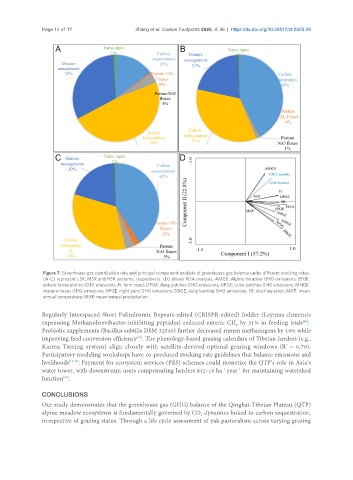
                Figure 7. Greenhouse gas contribution rate and principal component analysis of greenhouse gas balance under different stocking rates.
                (A-C) represent LSR, MSR and HSR systems, respectively. (D) shows RDA analysis. AMGE: Alpine meadow GHG emissions; EFGE:
                enteric fermentation GHG emissions; FI: farm input; DPGE: dung patches GHG emissions; UPGE: urine patches GHG emissions; MHGE:
                manure heaps GHG emissions; NPGE: night pens GHG emissions; DBGE: dung burning GHG emissions; SR: stocking rates; MAT: mean
                annual temperature; MAP: mean annual precipitation.

               Regularly Interspaced Short Palindromic Repeats-edited (CRISPR-edited) fodder (Leymus chinensis
               expressing Methanobrevibacter-inhibiting peptides) reduced enteric CH  by 31% in feeding trials .
                                                                                                       [46]
                                                                                 4
               Probiotic supplements (Bacillus subtilis DSM 32540) further decreased rumen methanogens by 19% while
               improving feed conversion efficiency . The phenology-based grazing calendars of Tibetan herders (e.g.,
                                               [47]
               Karma Tsering system) align closely with satellite-derived optimal grazing windows (R  = 0.79).
                                                                                                 2
               Participatory modeling workshops have co-produced stocking rate guidelines that balance emissions and
               livelihoods [14,48] . Payment for ecosystem services (PES) schemes could monetize the QTP’s role in Asia’s
                                                                                 -1
                                                                            -1
               water tower, with downstream users compensating herders $12-18 ha  year  for maintaining watershed
               function .
                      [22]
               CONCLUSIONS
               Our study demonstrates that the greenhouse gas (GHG) balance of the Qinghai-Tibetan Plateau (QTP)
               alpine meadow ecosystems is fundamentally governed by CO  dynamics linked to carbon sequestration,
                                                                     2
               irrespective of grazing status. Through a life cycle assessment of yak pastoralism across varying grazing

