


Page 16 - Read Online
P. 16
Page 12 of 17                   Zhang et al. Carbon Footprints 2025, 4, 36  https://dx.doi.org/10.20517/cf.2025.29


                                                -1
                                            -1
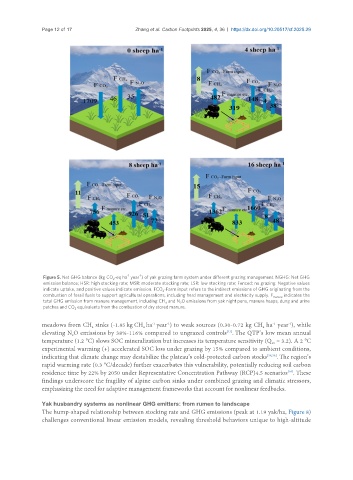
                Figure 5. Net GHG balance (kg CO -eq ha  year ) of yak grazing farm system under different grazing management. NGHG: Net GHG
                                       2
                emission balance; HSR: high stocking rate; MSR: moderate stocking rate; LSR: low stocking rate; Fenced: no grazing. Negative values
                indicate uptake, and positive values indicate emission. FCO -Farm input refers to the indirect emissions of GHG originating from the
                                                        2
                combustion of fossil fuels to support agricultural operations, including herd management and electricity supply. F   indicates the
                                                                                             manure
                total GHG emission from manure management, including CH  and N O emissions from yak night pens, manure heaps, dung and urine
                                                         4    2
                patches and CO  equivalents from the combustion of dry stored manure.
                          2
               meadows from CH  sinks (-1.85 kg CH  ha  year ) to weak sources (0.30-0.72 kg CH  ha  year ), while
                                                         -1
                                                    -1
                                                                                                  -1
                                                                                             -1
                                4
                                                                                          4
                                                 4
               elevating N O emissions by 38%-116% compared to ungrazed controls . The QTP’s low mean annual
                                                                             [22]
                         2
               temperature (1.2 °C) slows SOC mineralization but increases its temperature sensitivity (Q  = 3.2). A 2 °C
                                                                                             10
               experimental warming (+) accelerated SOC loss under grazing by 15% compared to ambient conditions,
               indicating that climate change may destabilize the plateau’s cold-protected carbon stocks [38,39] . The region’s
               rapid warming rate (0.3 °C/decade) further exacerbates this vulnerability, potentially reducing soil carbon
                                                                                                  [16]
               residence time by 22% by 2050 under Representative Concentration Pathway (RCP)4.5 scenarios . These
               findings underscore the fragility of alpine carbon sinks under combined grazing and climatic stressors,
               emphasizing the need for adaptive management frameworks that account for nonlinear feedbacks.
               Yak husbandry systems as nonlinear GHG emitters: from rumen to landscape
               The hump-shaped relationship between stocking rate and GHG emissions (peak at 1.19 yak/ha, Figure 8)
               challenges conventional linear emission models, revealing threshold behaviors unique to high-altitude

