


Page 17 - Read Online
P. 17
Zhang et al. Carbon Footprints 2025, 4, 36  https://dx.doi.org/10.20517/cf.2025.29  Page 13 of 17


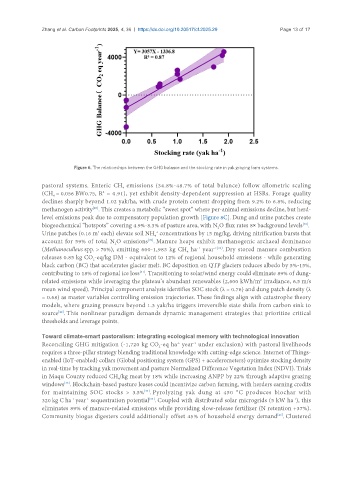
                          Figure 6. The relationships between the GHG balance and the stocking rate in yak grazing farm systems.

               pastoral systems. Enteric CH  emissions (34.8%-48.7% of total balance) follow allometric scaling
                                          4
                                    2
               (CH  = 0.056 BW0.75, R  = 0.91), yet exhibit density-dependent suppression at HSRs. Forage quality
                   4
               declines sharply beyond 1.02 yak/ha, with crude protein content dropping from 9.2% to 6.8%, reducing
               methanogen activity . This creates a metabolic “sweet spot” where per-animal emissions decline, but herd-
                                [25]
               level emissions peak due to compensatory population growth [Figure 8C]. Dung and urine patches create
                                                                                                       [40]
               biogeochemical “hotspots” covering 4.9%-8.3% of pasture area, with N O flux rates 8× background levels .
                                                                          2
               Urine patches (0.16 m  each) elevate soil NH  concentrations by 15 mg/kg, driving nitrification bursts that
                                  2
                                                      +
                                                     4
               account for 59% of total N O emissions . Manure heaps exhibit methanogenic archaeal dominance
                                                   [28]
                                        2
                                                                   -1
               (Methanoculleus spp. > 70%), emitting 600-1,983 kg CH  ha  year -1[22] . Dry stored manure combustion
                                                                4
               releases 0.85 kg CO -eq/kg DM - equivalent to 12% of regional household emissions - while generating
                                2
               black carbon (BC) that accelerates glacier melt. BC deposition on QTP glaciers reduces albedo by 5%-15%,
               contributing to 18% of regional ice loss . Transitioning to solar/wind energy could eliminate 89% of dung-
                                                [41]
                                                                                         2
               related emissions while leveraging the plateau’s abundant renewables (2,600 kWh/m  irradiance, 6.5 m/s
               mean wind speed). Principal component analysis identifies SOC stock (λ = 0.76) and dung patch density (λ
               = 0.68) as master variables controlling emission trajectories. These findings align with catastrophe theory
               models, where grazing pressure beyond 1.3 yak/ha triggers irreversible state shifts from carbon sink to
               source . This nonlinear paradigm demands dynamic management strategies that prioritize critical
                     [42]
               thresholds and leverage points.
               Toward climate-smart pastoralism: integrating ecological memory with technological innovation
                                                             -1
               Reconciling GHG mitigation (-1,720 kg CO -eq ha  year  under exclusion) with pastoral livelihoods
                                                                  -1
                                                       2
               requires a three-pillar strategy blending traditional knowledge with cutting-edge science. Internet of Things-
               enabled (IoT-enabled) collars (Global positioning system (GPS) + accelerometers) optimize stocking density
               in real-time by tracking yak movement and pasture Normalized Difference Vegetation Index (NDVI). Trials
               in Maqu County reduced CH /kg meat by 18% while increasing ANPP by 22% through adaptive grazing
                                         4
               windows . Blockchain-based pasture leases could incentivize carbon farming, with herders earning credits
                       [43]
                                                  [44]
               for  maintaining  SOC  stocks  >  3.5% . Pyrolyzing  yak  dung  at  450  °C  produces  biochar  with
               320 kg C ha  year  sequestration potential . Coupled with distributed solar microgrids (5 kW ha ), this
                                                                                                    -1
                         -1
                                                   [34]
                              -1
               eliminates 89% of manure-related emissions while providing slow-release fertilizer (N retention +37%).
               Community biogas digesters could additionally offset 45% of household energy demand . Clustered
                                                                                              [45]

