


Page 19 - Read Online
P. 19
Zhang et al. Carbon Footprints 2025, 4, 36  https://dx.doi.org/10.20517/cf.2025.29  Page 15 of 17


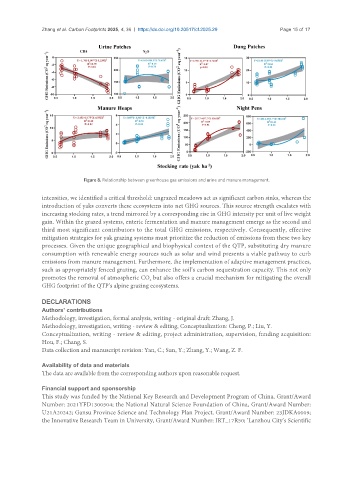
                             Figure 8. Relationship between greenhouse gas emissions and urine and manure management.

               intensities, we identified a critical threshold: ungrazed meadows act as significant carbon sinks, whereas the
               introduction of yaks converts these ecosystems into net GHG sources. This source strength escalates with
               increasing stocking rates, a trend mirrored by a corresponding rise in GHG intensity per unit of live weight
               gain. Within the grazed systems, enteric fermentation and manure management emerge as the second and
               third most significant contributors to the total GHG emissions, respectively. Consequently, effective
               mitigation strategies for yak grazing systems must prioritize the reduction of emissions from these two key
               processes. Given the unique geographical and biophysical context of the QTP, substituting dry manure
               consumption with renewable energy sources such as solar and wind presents a viable pathway to curb
               emissions from manure management. Furthermore, the implementation of adaptive management practices,
               such as appropriately fenced grazing, can enhance the soil’s carbon sequestration capacity. This not only
               promotes the removal of atmospheric CO  but also offers a crucial mechanism for mitigating the overall
                                                    2
               GHG footprint of the QTP’s alpine grazing ecosystems.

               DECLARATIONS
               Authors’ contributions
               Methodology, investigation, formal analysis, writing - original draft: Zhang, J.
               Methodology, investigation, writing - review & editing, Conceptualization: Cheng, P.; Liu, Y.
               Conceptualization, writing - review & editing, project administration, supervision, funding acquisition:
               Hou, F.; Chang, S.
               Data collection and manuscript revision: Yan, C.; Sun, Y.; Zhang, Y.; Wang, Z. F.

               Availability of data and materials
               The data are available from the corresponding authors upon reasonable request.

               Financial support and sponsorship
               This study was funded by the National Key Research and Development Program of China, Grant/Award
               Number: 2021YFD1300504; the National Natural Science Foundation of China, Grant/Award Number:
               U21A20242; Gansu Province Science and Technology Plan Project, Grant/Award Number: 23JDKA0009;
               the Innovative Research Team in University, Grant/Award Number: IRT_17R50; ‘Lanzhou City’s Scientific

