


Page 75 - Read Online
P. 75
Page 16 of 24                     Luo et al. Carbon Footprints 2025, 4, 14  https://dx.doi.org/10.20517/cf.2024.53


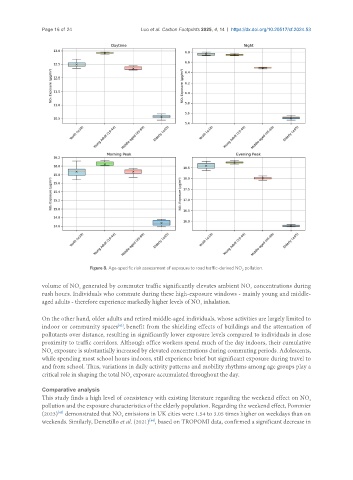
                               Figure 8. Age-specific risk assessment of exposure to road traffic-derived NO  pollution.
                                                                                   2
               volume of NO  generated by commuter traffic significantly elevates ambient NO  concentrations during
                            x
                                                                                     2
               rush hours. Individuals who commute during these high-exposure windows - mainly young and middle-
               aged adults - therefore experience markedly higher levels of NO  inhalation.
                                                                     2
               On the other hand, older adults and retired middle-aged individuals, whose activities are largely limited to
               indoor or community spaces , benefit from the shielding effects of buildings and the attenuation of
                                         [42]
               pollutants over distance, resulting in significantly lower exposure levels compared to individuals in close
               proximity to traffic corridors. Although office workers spend much of the day indoors, their cumulative
               NO  exposure is substantially increased by elevated concentrations during commuting periods. Adolescents,
                  2
               while spending most school hours indoors, still experience brief but significant exposure during travel to
               and from school. Thus, variations in daily activity patterns and mobility rhythms among age groups play a
               critical role in shaping the total NO  exposure accumulated throughout the day.
                                             2

               Comparative analysis
               This study finds a high level of consistency with existing literature regarding the weekend effect on NO
                                                                                                         2
               pollution and the exposure characteristics of the elderly population. Regarding the weekend effect, Pommier
               (2023)  demonstrated that NO  emissions in UK cities were 1.54 to 3.05 times higher on weekdays than on
                     [43]
                                          x
               weekends. Similarly, Demetillo et al. (2021) , based on TROPOMI data, confirmed a significant decrease in
                                                   [44]

