


Page 74 - Read Online
P. 74
Luo et al. Carbon Footprints 2025, 4, 14  https://dx.doi.org/10.20517/cf.2024.53  Page 15 of 24


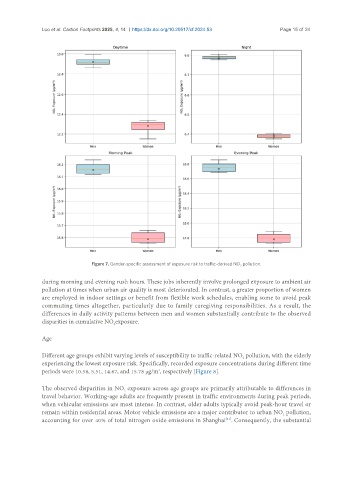
                                Figure 7. Gender-specific assessment of exposure risk to traffic-derived NO  pollution.
                                                                                  2
               during morning and evening rush hours. These jobs inherently involve prolonged exposure to ambient air
               pollution at times when urban air quality is most deteriorated. In contrast, a greater proportion of women
               are employed in indoor settings or benefit from flexible work schedules, enabling some to avoid peak
               commuting times altogether, particularly due to family caregiving responsibilities. As a result, the
               differences in daily activity patterns between men and women substantially contribute to the observed
               disparities in cumulative NO exposure.
                                       2
               Age


               Different age groups exhibit varying levels of susceptibility to traffic-related NO  pollution, with the elderly
                                                                                   2
               experiencing the lowest exposure risk. Specifically, recorded exposure concentrations during different time
               periods were 10.58, 5.51, 14.67, and 15.78 μg/m , respectively [Figure 8].
                                                      3

               The observed disparities in NO  exposure across age groups are primarily attributable to differences in
                                           2
               travel behavior. Working-age adults are frequently present in traffic environments during peak periods,
               when vehicular emissions are most intense. In contrast, older adults typically avoid peak-hour travel or
               remain within residential areas. Motor vehicle emissions are a major contributor to urban NO  pollution,
                                                                                                2
               accounting for over 40% of total nitrogen oxide emissions in Shanghai . Consequently, the substantial
                                                                             [41]

