


Page 72 - Read Online
P. 72
Luo et al. Carbon Footprints 2025, 4, 14  https://dx.doi.org/10.20517/cf.2024.53  Page 13 of 24


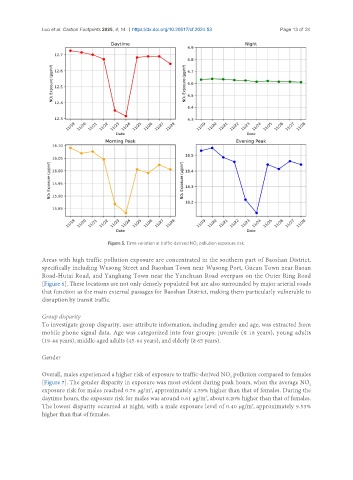
                                     Figure 5. Time variation in traffic-derived NO  pollution exposure risk.
                                                                   2
               Areas with high traffic pollution exposure are concentrated in the southern part of Baoshan District,
               specifically including Wusong Street and Baoshan Town near Wusong Port, Gucun Town near Baoan
               Road-Hutai Road, and Yanghang Town near the Yunchuan Road overpass on the Outer Ring Road
               [Figure 6]. These locations are not only densely populated but are also surrounded by major arterial roads
               that function as the main external passages for Baoshan District, making them particularly vulnerable to
               disruption by transit traffic.


               Group disparity
               To investigate group disparity, user attribute information, including gender and age, was extracted from
               mobile phone signal data. Age was categorized into four groups: juvenile (≤ 18 years), young adults
               (19-44 years), middle-aged adults (45-64 years), and elderly (≥ 65 years).

               Gender


               Overall, males experienced a higher risk of exposure to traffic-derived NO  pollution compared to females
                                                                               2
               [Figure 7]. The gender disparity in exposure was most evident during peak hours, when the average NO
                                                                                                         2
               exposure risk for males reached 0.76 μg/m , approximately 4.59% higher than that of females. During the
                                                    3
                                                                      3
               daytime hours, the exposure risk for males was around 0.61 μg/m , about 6.20% higher than that of females.
               The lowest disparity occurred at night, with a male exposure level of 0.40 μg/m , approximately 9.53%
                                                                                      3
               higher than that of females.

