


Page 73 - Read Online
P. 73
Page 14 of 24                     Luo et al. Carbon Footprints 2025, 4, 14  https://dx.doi.org/10.20517/cf.2024.53


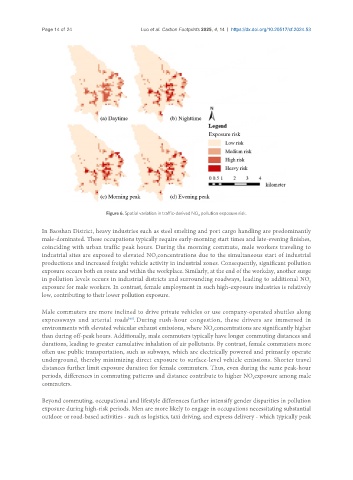
                                     Figure 6. Spatial variation in traffic-derived NO  pollution exposure risk.
                                                                    2

               In Baoshan District, heavy industries such as steel smelting and port cargo handling are predominantly
               male-dominated. These occupations typically require early-morning start times and late-evening finishes,
               coinciding with urban traffic peak hours. During the morning commute, male workers traveling to
               industrial sites are exposed to elevated NO concentrations due to the simultaneous start of industrial
                                                      2
               productions and increased freight vehicle activity in industrial zones. Consequently, significant pollution
               exposure occurs both en route and within the workplace. Similarly, at the end of the workday, another surge
               in pollution levels occurs in industrial districts and surrounding roadways, leading to additional NO
                                                                                                         2
               exposure for male workers. In contrast, female employment in such high-exposure industries is relatively
               low, contributing to their lower pollution exposure.


               Male commuters are more inclined to drive private vehicles or use company-operated shuttles along
                                            [40]
               expressways  and  arterial  roads . During  rush-hour  congestion,  these  drivers  are  immersed  in
               environments with elevated vehicular exhaust emissions, where NO concentrations are significantly higher
                                                                         2
               than during off-peak hours. Additionally, male commuters typically have longer commuting distances and
               durations, leading to greater cumulative inhalation of air pollutants. By contrast, female commuters more
               often use public transportation, such as subways, which are electrically powered and primarily operate
               underground, thereby minimizing direct exposure to surface-level vehicle emissions. Shorter travel
               distances further limit exposure duration for female commuters. Thus, even during the same peak-hour
               periods, differences in commuting patterns and distance contribute to higher NO exposure among male
                                                                                      2
               commuters.


               Beyond commuting, occupational and lifestyle differences further intensify gender disparities in pollution
               exposure during high-risk periods. Men are more likely to engage in occupations necessitating substantial
               outdoor or road-based activities - such as logistics, taxi driving, and express delivery - which typically peak

