


Page 14 - Read Online
P. 14
Page 8 of 12                                                      Hsu et al. Vessel Plus 2021;5:2  I  http://dx.doi.org/10.20517/2574-1209.2020.45


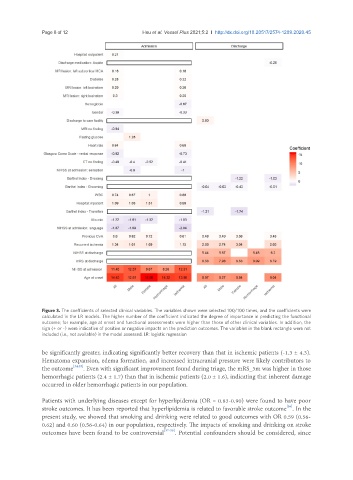
               Figure 3. The coefficients of selected clinical variables. The variables shown were selected 100/100 times, and the coefficients were
               calculated in the LR models. The higher number of the coefficient indicated the degree of importance in predicting the functional
               outcome; for example, age at onset and functional assessments were higher than those of other clinical variables. In addition, the
               sign (+ or -) were indicative of positive or negative impacts on the prediction outcomes. The variables in the blank rectangle were not
               included (i.e., not available) in the model assessed. LR: logistic regression

               be significantly greater, indicating significantly better recovery than that in ischemic patients (-1.3 ± 4.3).
               Hematoma expansion, edema formation, and increased intracranial pressure were likely contributors to
               the outcome [34,35] . Even with significant improvement found during triage, the mRS_3m was higher in those
               hemorrhagic patients (2.4 ± 1.7) than that in ischemic patients (2.0 ± 1.6), indicating that inherent damage
               occurred in older hemorrhagic patients in our population.

               Patients with underlying diseases except for hyperlipidemia (OR = 0.83-0.90) were found to have poor
                                                                                                  [36]
               stroke outcomes. It has been reported that hyperlipidemia is related to favorable stroke outcome . In the
               present study, we showed that smoking and drinking were related to good outcomes with OR 0.59 (0.56-
               0.62) and 0.60 (0.56-0.64) in our population, respectively. The impacts of smoking and drinking on stroke
               outcomes have been found to be controversial [37-39] . Potential confounders should be considered, since

