


Page 12 - Read Online
P. 12
Page 6 of 12                                                      Hsu et al. Vessel Plus 2021;5:2  I  http://dx.doi.org/10.20517/2574-1209.2020.45


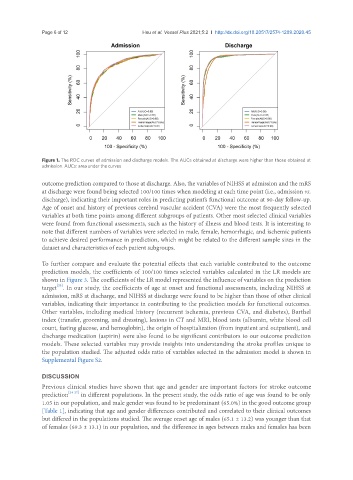
               Figure 1. The ROC curves of admission and discharge models. The AUCs obtained at discharge were higher than those obtained at
               admission. AUCs: area under the curves


               outcome prediction compared to those at discharge. Also, the variables of NIHSS at admission and the mRS
               at discharge were found being selected 100/100 times when modeling at each time point (i.e., admission vs.
               discharge), indicating their important roles in predicting patient’s functional outcome at 90-day follow-up.
               Age of onset and history of previous cerebral vascular accident (CVA) were the most frequently selected
               variables at both time points among different subgroups of patients. Other most selected clinical variables
               were found from functional assessments, such as the history of illness and blood tests. It is interesting to
               note that different numbers of variables were selected in male, female, hemorrhagic, and ischemic patients
               to achieve desired performance in prediction, which might be related to the different sample sizes in the
               dataset and characteristics of each patient subgroups.

               To further compare and evaluate the potential effects that each variable contributed to the outcome
               prediction models, the coefficients of 100/100 times selected variables calculated in the LR models are
               shown in Figure 3. The coefficients of the LR model represented the influence of variables on the prediction
                    [23]
               target . In our study, the coefficients of age at onset and functional assessments, including NIHSS at
               admission, mRS at discharge, and NIHSS at discharge were found to be higher than those of other clinical
               variables, indicating their importance in contributing to the prediction models for functional outcomes.
               Other variables, including medical history (recurrent ischemia, previous CVA, and diabetes), Barthel
               index (transfer, grooming, and dressing), lesions in CT and MRI, blood tests (albumin, white blood cell
               count, fasting glucose, and hemoglobin), the origin of hospitalization (from inpatient and outpatient), and
               discharge medication (aspirin) were also found to be significant contributors to our outcome prediction
               models. These selected variables may provide insights into understanding the stroke profiles unique to
               the population studied. The adjusted odds ratio of variables selected in the admission model is shown in
               Supplemental Figure S2.

               DISCUSSION
               Previous clinical studies have shown that age and gender are important factors for stroke outcome
               prediction [24-27]  in different populations. In the present study, the odds ratio of age was found to be only
               1.05 in our population, and male gender was found to be predominant (65.0%) in the good outcome group
               [Table 1], indicating that age and gender differences contributed and correlated to their clinical outcomes
               but differed in the populations studied. The average onset age of males (65.1 ± 13.2) was younger than that
               of females (69.3 ± 13.1) in our population, and the difference in ages between males and females has been

