


Page 76 - Read Online
P. 76
Page 8 of 22                                                          Na et al. Soft Sci. 2026, 6, 25


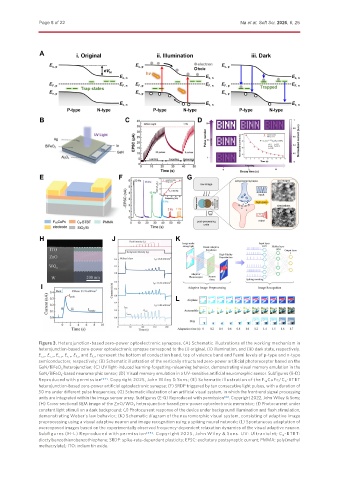
               Figure 3. Heterojunction-based zero-power optoelectronic synapses. (A) Schematic illustrations of the working mechanism in
               heterojunction-based zero-power optoelectronic synapse correspond to the (i) original, (ii) illumination, and (iii) dark state, respectively.
               E c, p , E c, n , E v, p , E v, n , E F, p  and E F, n  represent the bottom of conduction band, top of valence band and Fermi levels of p-type and n-type
               semiconductors, respectively; (B) Schematic illustration of the vertically structured zero-power artificial photoreceptor based on the
               GaN/BiFeO 3  heterojunction; (C) UV light-induced learning-forgetting-relearning behavior, demonstrating visual memory emulation in the
               GaN/BiFeO 3 -based neuromorphic sensor; (D) Visual memory emulation in a UV-sensitive artificial neuromorphic sensor. Subfigures (B-D)
               Reproduced with permission [37] . Copyright 2025, John Wiley & Sons; (E) Schematic illustration of the F 16 CuPc/C 8 -BTBT
               heterojunction-based zero-power artificial optoelectronic synapse; (F) SRDP triggered by ten consecutive light pulses, with a duration of
               50 ms under different pulse frequencies; (G) Schematic illustration of an artificial visual system, in which the front-end signal processing
               units are integrated within the image sensor array. Subfigures (E-G) Reproduced with permission [38] . Copyright 2022, John Wiley & Sons;
               (H) Cross-sectional SEM image of the ZnO/WO X  heterojunction-based zero-power optoelectronic memristor; (I) Photocurrent under
               constant light stimuli on a dark background; (J) Photocurrent response of the device under background illumination and flash stimulation,
               demonstrating Weber’s law behavior; (K) Schematic diagram of the neuromorphic visual system, consisting of adaptive image
               preprocessing using a visual adaptive neuron and image recognition using a spiking neural network; (L) Spontaneous adaptation of
               overexposed images based on the experimentally observed frequency-dependent relaxation dynamics of the visual adaptive neuron.
               Subfigures (H-L) Reproduced with permission [ 39 ] . Copyright 2025, John Wiley & Sons. UV: Ultraviolet; C 8 -BTBT:
               dioctylbenzothienobenzothiophene; SRDP: spike-rate-dependent plasticity; EPSC: excitatory postsynaptic current; PMMA: poly(methyl
               methacrylate); ITO: indium tin oxide.

