


Page 71 - Read Online
P. 71
Na et al. Soft Sci. 2026, 6, 25                                                   Page 3 of 22


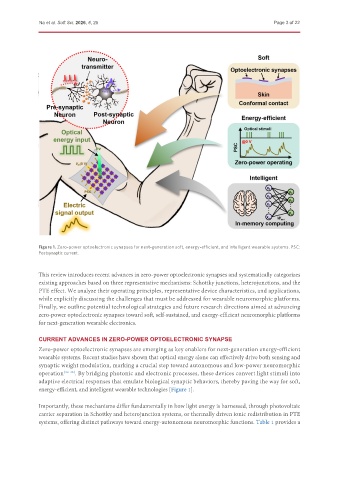
               Figure 1. Zero-power optoelectronic synapses for next-generation soft, energy-efficient, and intelligent wearable systems. PSC:
               Postsynaptic current.


               This review introduces recent advances in zero-power optoelectronic synapses and systematically categorizes
               existing approaches based on three representative mechanisms: Schottky junctions, heterojunctions, and the
               PTE effect. We analyze their operating principles, representative device characteristics, and applications,
               while explicitly discussing the challenges that must be addressed for wearable neuromorphic platforms.
               Finally, we outline potential technological strategies and future research directions aimed at advancing
               zero-power optoelectronic synapses toward soft, self-sustained, and energy-efficient neuromorphic platforms
               for next-generation wearable electronics.


               CURRENT ADVANCES IN ZERO-POWER OPTOELECTRONIC SYNAPSE
               Zero-power optoelectronic synapses are emerging as key enablers for next-generation energy-efficient
               wearable systems. Recent studies have shown that optical energy alone can effectively drive both sensing and
               synaptic weight modulation, marking a crucial step toward autonomous and low-power neuromorphic
               operation [32-45] . By bridging photonic and electronic processes, these devices convert light stimuli into
               adaptive electrical responses that emulate biological synaptic behaviors, thereby paving the way for soft,
               energy-efficient, and intelligent wearable technologies [Figure 1].


               Importantly, these mechanisms differ fundamentally in how light energy is harnessed, through photovoltaic
               carrier separation in Schottky and heterojunction systems, or thermally driven ionic redistribution in PTE
               systems, offering distinct pathways toward energy-autonomous neuromorphic functions. Table 1 provides a

