


Page 72 - Read Online
P. 72
Page 4 of 22                                                          Na et al. Soft Sci. 2026, 6, 25


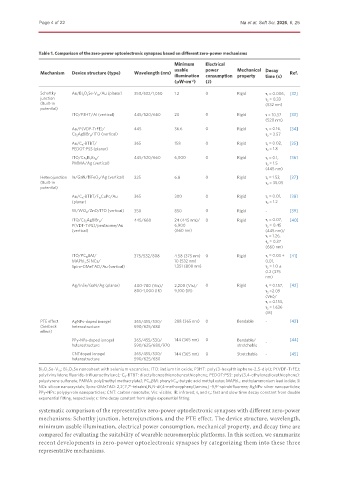
               Table 1. Comparison of the zero-power optoelectronic synapses based on different zero-power mechanisms
                                                              Minimum    Electrical
                                                              usable     power      Mechanical Decay
               Mechanism  Device structure (type)  Wavelength (nm)                                     Ref.
                                                              illumination  consumption property  time (s)
                                                              (μW·cm )   (J)
                                                                    -2
               Schottky   Au/Bi 2 O 2 Se-V Se /Au (planar)  350/532/1,050  1.2  0   Rigid     τ 1  = 0.006,  [32]
               junction                                                                       τ 2  = 0.33
               (Built-in                                                                      (532 nm)
               potential)
                          ITO/P3HT/Al (vertical)  445/520/660  20        0          Rigid     τ = 10.37  [33]
                                                                                              (520 nm)
                          Au/P(VDF-TrFE)/       445           36.6       0          Rigid     τ 1  = 0.16,  [34]
                          Cs 2 AgBiBr 6 /ITO (vertical)                                       τ 2  = 3.57
                          Au/C 8 -BTBT/         365           158        0          Rigid     τ 1  = 0.02,  [35]
                          PEDOT:PSS (planar)                                                  τ 2  = 1.8
                          ITO/Cs 3 Bi 2 Br 9 /  445/520/660   6,000      0          Rigid     τ 1  = 0.1,  [36]
                          PMMA/Ag (vertical)                                                  τ 2  = 1.5
                                                                                              (445 nm)
               Heterojunction  In/GaN/BiFeO 3 /Ag (vertical)  325  6.8   0          Rigid     τ 1  = 1.52,  [37]
               (Built-in                                                                      τ 2  = 35.05
               potential)
                          Au/C 8 -BTBT/F 16 CuPc/Au  365      300        0          Rigid     τ 1  = 0.01,  [38]
                          (planar)                                                            τ 2  = 1.2
                          W/WO X /ZnO/ITO (vertical)  350     850        0          Rigid     -        [39]
                          ITO/Cs 2 AgBiBr 6 /   445/660       24 (445 nm)/  0       Rigid     τ 1  = 0.07,  [40]
                          P(VDF-TrFE)/pentacene/Au            6,900                           τ 2  = 0.45
                          (vertical)                          (660 nm)                        (445 nm)/
                                                                                              τ 1  = 1.26,
                                                                                              τ 2  = 0.37
                                                                                              (660 nm)
                          ITO/PC 61 BM/         375/532/808   4.58 (375 nm)  0      Rigid     τ 1  = 0.03 ±  [41]
                          MAPbI 3 :Si NCs/                    10 (532 nm)                     0.01,
                          Spiro-OMeTAD/Au (vertical)          1,351 (808 nm)                  τ 2  = 1.0 ±
                                                                                              0.2 (375
                                                                                              nm)
                          Ag/InSe/GaN/Ag (planar)  400-780 (Vis)/  2,200 (Vis)/  0  Rigid     τ 1  = 0.157,  [42]
                                                800-1,000 (IR)  9,100 (IR)                    τ 2  =2.09
                                                                                              (Vis)/
                                                                                              τ 1  = 0.153,
                                                                                              τ 2  = 1.636
                                                                                              (IR)
               PTE effect  AgNPs-doped ionogel  365/455/530/  288 (365 nm)  0       Bendable  -        [43]
               (Seebeck   heterostructure       590/625/680
               effect)
                          PPy-NPs-doped ionogel  365/455/530/  144 (365 nm)  0      Bendable/  -       [44]
                          heterostructure       590/625/680/970                     stretchable
                          CNTdoped ionogel      365/455/530/  144 (365 nm)  0       Stretchable  -     [45]
                          heterostructure       590/625/680
               Bi 2 O 2 Se-V Se : Bi 2 O 2 Se nanosheet with selenium vacancies; ITO: indium tin oxide; P3HT: poly(3-hexylthiophene-2,5-diyl); P(VDF-TrFE):
               poly(vinylidene fluoride-trifluoroethylene); C 8 -BTBT: dioctylbenzothienobenzothiophene; PEDOT:PSS: poly(3,4-ethylenedioxythiophene):
               polystyrene sulfonate; PMMA: poly(methyl methacrylate); PC 61 BM: phenyl-C 61 -butyric acid methyl ester; MAPbI 3 : methylammonium lead iodide; Si
               NCs: silicon nanocrystals; Spiro-OMeTAD: 2,2′,7,7′-tetrakis[N,N-di(4-methoxyphenyl)amino] -9,9′-spirobifluorene; AgNPs: silver nanoparticles;
               PPy-NPs: polypyrrole nanoparticles; CNT: carbon nanotube; Vis: visible; IR: infrared; τ 1  and τ 2 : fast and slow time decay constant from double
               exponential fitting, respectively; τ: time decay constant from single exponential fitting.
               systematic comparison of the representative zero-power optoelectronic synapses with different zero-power
               mechanisms: Schottky junction, heterojunctions, and the PTE effect. The device structure, wavelength,
               minimum usable illumination, electrical power consumption, mechanical property, and decay time are
               compared for evaluating the suitability of wearable neuromorphic platforms. In this section, we summarize
               recent developments in zero-power optoelectronic synapses by categorizing them into these three
               representative mechanisms.

