


Page 79 - Read Online
P. 79
Na et al. Soft Sci. 2026, 6, 25                                                  Page 11 of 22


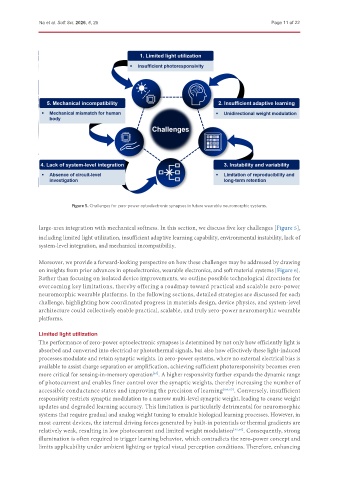
                          Figure 5. Challenges for zero-power optoelectronic synapses in future wearable neuromorphic systems.


               large-area integration with mechanical softness. In this section, we discuss five key challenges [Figure 5],

               including limited light utilization, insufficient adaptive learning capability, environmental instability, lack of
               system-level integration, and mechanical incompatibility.

               Moreover, we provide a forward-looking perspective on how these challenges may be addressed by drawing
               on insights from prior advances in optoelectronics, wearable electronics, and soft material systems [Figure 6].
               Rather than focusing on isolated device improvements, we outline possible technological directions for
               overcoming key limitations, thereby offering a roadmap toward practical and scalable zero-power
               neuromorphic wearable platforms. In the following sections, detailed strategies are discussed for each
               challenge, highlighting how coordinated progress in materials design, device physics, and system-level
               architecture could collectively enable practical, scalable, and truly zero-power neuromorphic wearable
               platforms.

               Limited light utilization
               The performance of zero-power optoelectronic synapses is determined by not only how efficiently light is
               absorbed and converted into electrical or photothermal signals, but also how effectively these light-induced
               processes modulate and retain synaptic weights. In zero-power systems, where no external electrical bias is
               available to assist charge separation or amplification, achieving sufficient photoresponsivity becomes even
               more critical for sensing-in-memory operation . A higher responsivity further expands the dynamic range
                                                       [63]
               of photocurrent and enables finer control over the synaptic weights, thereby increasing the number of
               accessible conductance states and improving the precision of learning [64,65] . Conversely, insufficient
               responsivity restricts synaptic modulation to a narrow multi-level synaptic weight, leading to coarse weight
               updates and degraded learning accuracy. This limitation is particularly detrimental for neuromorphic
               systems that require gradual and analog weight tuning to emulate biological learning processes. However, in
               most current devices, the internal driving forces generated by built-in potentials or thermal gradients are
               relatively weak, resulting in low photocurrent and limited weight modulation [42,66] . Consequently, strong
               illumination is often required to trigger learning behavior, which contradicts the zero-power concept and
               limits applicability under ambient lighting or typical visual perception conditions. Therefore, enhancing

