


Page 95 - Read Online
P. 95
Page 10 of 16                           Sun et al. Soft Sci. 2025, 5, 35  https://dx.doi.org/10.20517/ss.2025.21


               If C  maintains a constant value implying that loss originates from eddy current loss, it is clearly observed
                  0
               that the C -f curve shows a flat spreading region attributed to eddy current loss within 6-8 GHz; however,
                        0
               the C -f curve fluctuates in 2-6 GHz indicating that natural resonance is the main contribution. Meanwhile,
                    0
               the C -f curve fluctuates considerably between 8-18 GHz, indicating an exchange resonance at high
                    0
               frequencies [Supplementary Figure 4A].
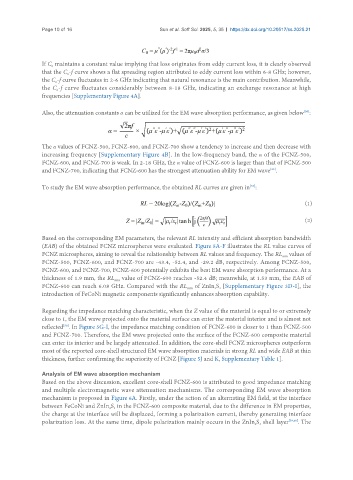
               Also, the attenuation constants α can be utilized for the EM wave absorption performance, as given below :
                                                                                                       [56]


               The α values of FCNZ-500, FCNZ-600, and FCNZ-700 show a tendency to increase and then decrease with
               increasing frequency [Supplementary Figure 4B]. In the low-frequency band, the α of the FCNZ-500,
               FCNZ-600, and FCNZ-700 is weak. In 2-18 GHz, the α value of FCNZ-600 is larger than that of FCNZ-500
               and FCNZ-700, indicating that FCNZ-600 has the strongest attenuation ability for EM wave .
                                                                                            [23]

                                                                                     [57]
               To study the EM wave absorption performance, the obtained RL curves are given in :
                                                                                                        (1)


                                                                                                        (2)

               Based on the corresponding EM parameters, the relevant RL intensity and efficient absorption bandwidth
               (EAB) of the obtained FCNZ microspheres were evaluated. Figure 5A-F illustrates the RL value curves of
               FCNZ microspheres, aiming to reveal the relationship between RL values and frequency. The RL  values of
                                                                                                min
               FCNZ-500, FCNZ-600, and FCNZ-700 are -43.4, -52.4, and -29.2 dB, respectively. Among FCNZ-500,
               FCNZ-600, and FCNZ-700, FCNZ-600 potentially exhibits the best EM wave absorption performance. At a
               thickness of 1.9 mm, the RL  value of FCNZ-600 reaches -52.4 dB; meanwhile, at 1.53 mm, the EAB of
                                        min
               FCNZ-600 can reach 6.08 GHz. Compared with the RL  of ZnIn S  [Supplementary Figure 3D-I], the
                                                                min
                                                                         2 4
               introduction of FeCoNi magnetic components significantly enhances absorption capability.
               Regarding the impedance matching characteristic, when the Z value of the material is equal to or extremely
               close to 1, the EM wave projected onto the material surface can enter the material interior and is almost not
                      [58]
               reflected . In Figure 5G-I, the impedance matching condition of FCNZ-600 is closer to 1 than FCNZ-500
               and FCNZ-700. Therefore, the EM wave projected onto the surface of the FCNZ-600 composite material
               can enter its interior and be largely attenuated. In addition, the core-shell FCNZ microspheres outperform
               most of the reported core-shell structured EM wave absorption materials in strong RL and wide EAB at thin
               thickness, further confirming the superiority of FCNZ [Figure 5J and K, Supplementary Table 1].

               Analysis of EM wave absorption mechanism
               Based on the above discussion, excellent core-shell FCNZ-600 is attributed to good impedance matching
               and multiple electromagnetic wave attenuation mechanisms. The corresponding EM wave absorption
               mechanism is proposed in Figure 6A. Firstly, under the action of an alternating EM field, at the interface
               between FeCoNi and ZnIn S  in the FCNZ-600 composite material, due to the difference in EM properties,
                                      2 4
               the charge at the interface will be displaced, forming a polarization current, thereby generating interface
               polarization loss. At the same time, dipole polarization mainly occurs in the ZnIn S  shell layer [59,60] . The
                                                                                       2 4

