


Page 97 - Read Online
P. 97
Page 12 of 16                           Sun et al. Soft Sci. 2025, 5, 35  https://dx.doi.org/10.20517/ss.2025.21


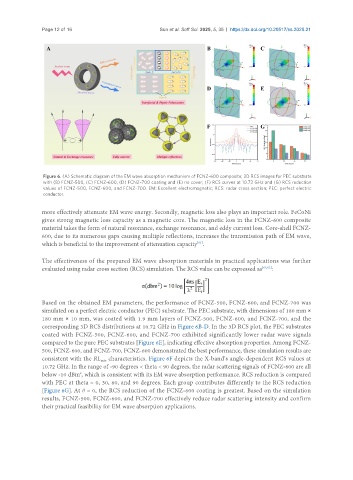
                Figure 6. (A) Schematic diagram of the EM wave absorption mechanism of FCNZ-600 composite; 3D RCS images for PEC substrate
                with (B) FCNZ-500, (C) FCNZ-600, (D) FCNZ-700 coating and (E) no cover; (F) RCS curves at 10.72 GHz and (G) RCS reduction
                values of FCNZ-500, FCNZ-600, and FCNZ-700. EM: Excellent electromagnetic; RCS: radar cross section; PEC: perfect electric
                conductor.


               more effectively attenuate EM wave energy. Secondly, magnetic loss also plays an important role. FeCoNi
               gives strong magnetic loss capacity as a magnetic core. The magnetic loss in the FCNZ-600 composite
               material takes the form of natural resonance, exchange resonance, and eddy current loss. Core-shell FCNZ-
               600, due to its numerous gaps causing multiple reflections, increases the transmission path of EM wave,
               which is beneficial to the improvement of attenuation capacity .
                                                                   [61]

               The effectiveness of the prepared EM wave absorption materials in practical applications was further
               evaluated using radar cross section (RCS) simulation. The RCS value can be expressed as [62,63] :


               Based on the obtained EM parameters, the performance of FCNZ-500, FCNZ-600, and FCNZ-700 was
               simulated on a perfect electric conductor (PEC) substrate. The PEC substrate, with dimensions of 180 mm ×
               180 mm × 10 mm, was coated with 1.9 mm layers of FCNZ-500, FCNZ-600, and FCNZ-700, and the
               corresponding 3D RCS distributions at 10.72 GHz in Figure 6B-D. In the 3D RCS plot, the PEC substrates
               coated with FCNZ-500, FCNZ-600, and FCNZ-700 exhibited significantly lower radar wave signals
               compared to the pure PEC substrates [Figure 6E], indicating effective absorption properties. Among FCNZ-
               500, FCNZ-600, and FCNZ-700, FCNZ-600 demonstrated the best performance, these simulation results are
               consistent with the RL  characteristics. Figure 6F depicts the X-band’s angle-dependent RCS values at
                                   min
               10.72 GHz. In the range of -90 degrees < theta < 90 degrees, the radar scattering signals of FCNZ-600 are all
                            2
               below -10 dBm , which is consistent with its EM wave absorption performance. RCS reduction is compared
               with PEC at theta = 0, 30, 60, and 90 degrees. Each group contributes differently to the RCS reduction
               [Figure 6G]. At θ = 0, the RCS reduction of the FCNZ-600 coating is greatest. Based on the simulation
               results, FCNZ-500, FCNZ-600, and FCNZ-700 effectively reduce radar scattering intensity and confirm
               their practical feasibility for EM wave absorption applications.

