


Page 125 - Read Online
P. 125
Page 4 of 8                            Xiao et al. Soft Sci. 2025, 5, 40  https://dx.doi.org/10.20517/ss.2025.51

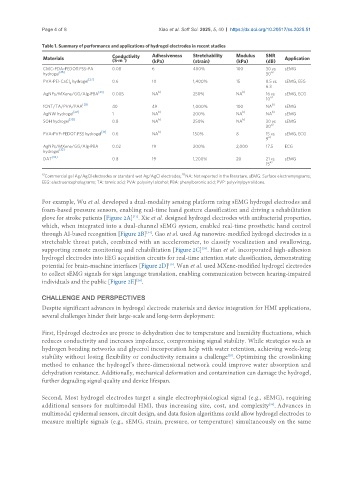
               Table 1. Summary of performance and applications of hydrogel electrodes in recent studies

                Materials              Conductivity   Adhesiveness   Stretchability   Modulus   SNR   Application
                                          -1
                                       (S·m )
                                                                  (strain)
                                                    (kPa)
                                                                                           (dB)
                                                                                 (kPa)
                CMC-PDA-PEDOT:PSS-PA   0.08         6             400%           100       30 vs.   sEMG
                hydrogel [26]                                                              30 a)
                               [27]
                PVA-PEI-CaCl  hydrogel  0.6         10            1,400%         15        8.5 vs.   sEMG, EEG
                        2
                                                                                           6.3
                                  [23]                b)                           b)
                AgNPs/MXene/GG/Alg-PBA  0.005       NA            250%           NA        16 vs.   sEMG, ECG
                                                                                            a)
                                                                                           10
                fCNT/TA/PVA/PAA [28]   40           49            1,000%         100       NA b)  sEMG
                          [29]                        b)                           b)        b)
                AgNW hydrogel          1            NA            200%           NA        NA    sEMG
                SOH hydrogel [30]      0.8          NA b)         250%           NA b)     30 vs.   sEMG
                                                                                            a)
                                                                                           30
                PVA-PVP-PEDOT:PSS hydrogel [31]  0.6  NA b)       150%           8         15 vs.   sEMG, ECG
                                                                                            a)
                                                                                           9
                AgNPs/MXene/GG/Alg-PBA   0.02       19            200%           2,000     17.5   ECG
                     [32]
                hydrogel
                DAT [33]               0.8          19            1,200%         20        21 vs.   sEMG
                                                                                            a)
                                                                                           15
               a)                                              b)
                Commercial gel Ag/AgCl electrodes or standard wet Ag/AgCl electrodes;  NA: Not reported in the literature. sEMG: Surface electromyograms;
               EEG: electroencephalograms; TA: tannic acid; PVA: polyvinyl alcohol; PBA: phenylboronic acid; PVP: polyvinylpyrrolidone.
               For example, Wu et al. developed a dual-modality sensing platform using sEMG hydrogel electrodes and
               foam-based pressure sensors, enabling real-time hand gesture classification and driving a rehabilitation
               glove for stroke patients [Figure 2A] . Xie et al. designed hydrogel electrodes with antibacterial properties,
                                              [17]
               which, when integrated into a dual-channel sEMG system, enabled real-time prosthetic hand control
                                                  [34]
               through AI-based recognition [Figure 2B] . Gao et al. used Ag nanowire-modified hydrogel electrodes in a
               stretchable throat patch, combined with an accelerometer, to classify vocalization and swallowing,
               supporting remote monitoring and rehabilitation [Figure 2C] . Han et al. incorporated high-adhesion
                                                                     [29]
               hydrogel electrodes into EEG acquisition circuits for real-time attention state classification, demonstrating
                                                          [19]
               potential for brain-machine interfaces [Figure 2D] . Wan et al. used MXene-modified hydrogel electrodes
               to collect sEMG signals for sign language translation, enabling communication between hearing-impaired
               individuals and the public [Figure 2E] .
                                               [24]
               CHALLENGE AND PERSPECTIVES
               Despite significant advances in hydrogel electrode materials and device integration for HMI applications,
               several challenges hinder their large-scale and long-term deployment:

               First, Hydrogel electrodes are prone to dehydration due to temperature and humidity fluctuations, which
               reduces conductivity and increases impedance, compromising signal stability. While strategies such as
               hydrogen bonding networks and glycerol incorporation help with water retention, achieving week-long
               stability without losing flexibility or conductivity remains a challenge . Optimizing the crosslinking
                                                                              [35]
               method to enhance the hydrogel’s three-dimensional network could improve water absorption and
               dehydration resistance. Additionally, mechanical deformation and contamination can damage the hydrogel,
               further degrading signal quality and device lifespan.


               Second, Most hydrogel electrodes target a single electrophysiological signal (e.g., sEMG), requiring
               additional sensors for multimodal HMI, thus increasing size, cost, and complexity . Advances in
                                                                                            [36]
               multimodal epidermal sensors, circuit design, and data fusion algorithms could allow hydrogel electrodes to
               measure multiple signals (e.g., sEMG, strain, pressure, or temperature) simultaneously on the same

