


Page 124 - Read Online
P. 124
Xiao et al. Soft Sci. 2025, 5, 40  https://dx.doi.org/10.20517/ss.2025.51        Page 3 of 8


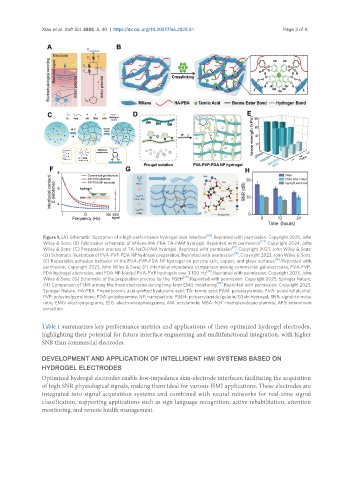
                Figure 1. (A) Schematic illustration of a high-performance hydrogel-skin interface [20] . Reprinted with permission. Copyright 2025, John
                Wiley & Sons; (B) Fabrication schematic of MXene-HA-PBA-TA-PAM hydrogel. Reprinted with  permission [24] . Copyright 2024, John
                Wiley & Sons; (C) Preparation process of TA-NaCl-PAM hydrogel. Reprinted with  permission [17] . Copyright 2023, John Wiley & Sons;
                (D) Schematic illustration of PVA-PVP-PDA NP hydrogel preparation. Reprinted with permission [19] . Copyright 2023, John Wiley & Sons;
                (E) Repeatable adhesion behavior of the PVA-PVP-PDA NP hydrogel on porcine skin, copper, and glass  surfaces [19] . Reprinted with
                permission. Copyright 2023, John Wiley & Sons; (F) Interfacial impedance comparison among commercial gel electrodes, PVA-PVP-
                PDA hydrogel electrodes, and PDA NP-loaded PVA-PVP hydrogels over 1-100 Hz [19] . Reprinted with permission. Copyright 2023, John
                Wiley & Sons; (G) Schematic of the preparation process for the PGEH [25] . Reprinted with permission. Copyright 2025, Springer Nature;
                (H) Comparison of SNR among the three electrodes during long-term EMG monitoring [25] . Reprinted with permission. Copyright 2025,
                Springer Nature. HA-PBA: Phenylboronic acid-grafted hyaluronic acid; TA: tannic acid; PAM: polyacrylamide; PVA: polyvinyl alcohol;
                PVP: polyvinylpyrrolidone; PDA: polydopamine; NP: nanoparticle; PGEH: polyacrylamide/gelatin/EGaIn hydrogel; SNR: signal-to-noise
                ratio; EMG: electromyograms; EEG: electroencephalograms; AM: acrylamide; MBA: N,N’-methylenebisacrylamide; APS: ammonium
                persulfate.


               Table 1 summarizes key performance metrics and applications of these optimized hydrogel electrodes,
               highlighting their potential for future interface engineering and multifunctional integration, with higher
               SNR than commercial electrodes.


               DEVELOPMENT AND APPLICATION OF INTELLIGENT HMI SYSTEMS BASED ON
               HYDROGEL ELECTRODES
               Optimized hydrogel electrodes enable low-impedance skin-electrode interfaces, facilitating the acquisition
               of high SNR physiological signals, making them ideal for various HMI applications. These electrodes are
               integrated into signal acquisition systems and combined with neural networks for real-time signal
               classification, supporting applications such as sign language recognition, active rehabilitation, attention
               monitoring, and remote health management.

