


Page 105 - Read Online
P. 105
Page 12 of 19                         Huang et al. Soft Sci. 2025, 5, 24  https://dx.doi.org/10.20517/ss.2025.07


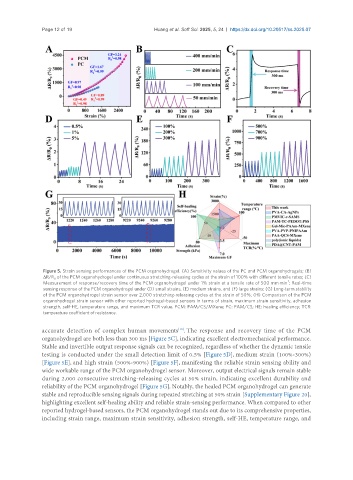
                Figure 5. Strain sensing performances of the PCM organohydrogel. (A) Sensitivity values of the PC and PCM organohydrogels; (B)
                ΔR/R  of the PCM organohydrogel under continuous stretching-releasing cycles at the strain of 100% with different tensile rates; (C)
                   0
                                                                                                  -1
                Measurement of response/recovery time of the PCM organohydrogel under 1% strain at a tensile rate of 500 mm·min ; Real-time
                sensing response of the PCM organohydrogel under (D) small strains, (E) medium strains, and (F) large strains; (G) Long-term stability
                of the PCM organohydrogel strain sensor over 2,000 stretching-releasing cycles at the strain of 50%; (H) Comparison of the PCM
                organohydrogel strain sensor with other reported hydrogel-based sensors in terms of strain, maximum strain sensitivity, adhesion
                strength, self-HE, temperature range, and maximum TCR value. PCM: PAM/CS/MXene; PC: PAM/CS; HE: healing efficiency; TCR:
                temperature coefficient of resistance.

               accurate detection of complex human movements . The response and recovery time of the PCM
                                                             [10]
               organohydrogel are both less than 300 ms [Figure 5C], indicating excellent electromechanical performance.
               Stable and invertible output response signals can be recognized, regardless of whether the dynamic tensile
               testing is conducted under the small detection limit of 0.5% [Figure 5D], medium strain (100%-300%)
               [Figure 5E], and high strain (500%-900%) [Figure 5F], manifesting the reliable strain sensing ability and
               wide workable range of the PCM organohydrogel sensor. Moreover, output electrical signals remain stable
               during 2,000 consecutive stretching-releasing cycles at 50% strain, indicating excellent durability and
               reliability of the PCM organohydrogel [Figure 5G]. Notably, the healed PCM organohydrogel can generate
               stable and reproducible sensing signals during repeated stretching at 50% strain [Supplementary Figure 20],
               highlighting excellent self-healing ability and reliable strain-sensing performance. When compared to other
               reported hydrogel-based sensors, the PCM organohydrogel stands out due to its comprehensive properties,
               including strain range, maximum strain sensitivity, adhesion strength, self-HE, temperature range, and

