


Page 103 - Read Online
P. 103
Page 10 of 19                         Huang et al. Soft Sci. 2025, 5, 24  https://dx.doi.org/10.20517/ss.2025.07


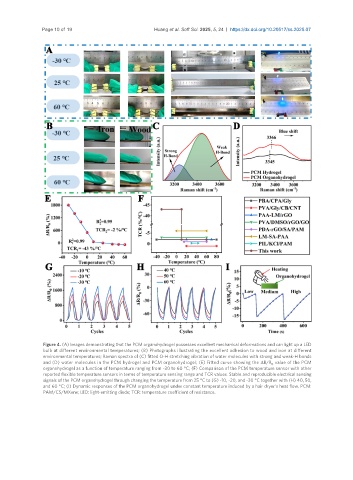
                Figure 4. (A) Images demonstrating that the PCM organohydrogel possesses excellent mechanical deformations and can light up a LED
                bulb at different environmental temperatures; (B) Photographs illustrating the excellent adhesion to wood and iron at different
                environmental temperatures; Raman spectra of (C) fitted O-H stretching vibration of water molecules with strong and weak-H bonds
                and (D) water molecules in the PCM hydrogel and PCM organohydrogel; (E) Fitted curve showing the ΔR/R  value of the PCM
                                                                                             0
                organohydrogel as a function of temperature ranging from -30 to 60 °C; (F) Comparison of the PCM temperature sensor with other
                reported flexible temperature sensors in terms of temperature sensing range and TCR values. Stable and reproducible electrical sensing
                signals of the PCM organohydrogel through changing the temperature from 25 °C to (G) -10, -20, and -30 °C together with (H) 40, 50,
                and 60 °C; (I) Dynamic responses of the PCM organohydrogel under constant temperature induced by a hair dryer’s heat flow. PCM:
                PAM/CS/MXene; LED: light-emitting diode; TCR: temperature coefficient of resistance.

