


Page 107 - Read Online
P. 107
Page 14 of 19                         Huang et al. Soft Sci. 2025, 5, 24  https://dx.doi.org/10.20517/ss.2025.07


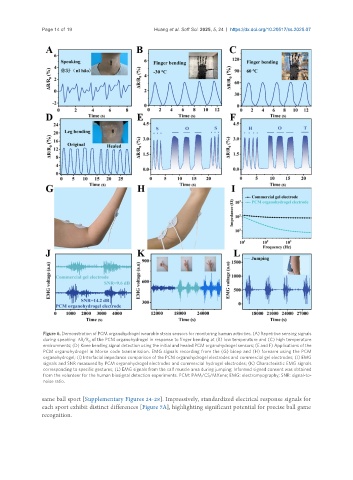
                Figure 6. Demonstration of PCM organohydrogel wearable strain sensors for monitoring human activities. (A) Repetitive sensing signals
                during speaking. ΔR/R  of the PCM organohydrogel in response to finger bending at (B) low temperature and (C) high temperature
                               0
                environments; (D) Knee bending signal detection using the initial and healed PCM organohydrogel sensors; (E and F) Applications of the
                PCM organohydrogel in Morse code transmission. EMG signals recording from the (G) bicep and (H) forearm using the PCM
                organohydrogel; (I) Interfacial impedance comparison of the PCM organohydrogel electrodes and commercial gel electrodes; (J) EMG
                signals and SNR measured by PCM organohydrogel electrodes and commercial hydrogel electrodes; (K) Characteristic EMG signals
                corresponding to specific gestures; (L) EMG signals from the calf muscle area during jumping; Informed signed consent was obtained
                from the volunteer for the human biosignal detection experiments. PCM: PAM/CS/MXene; EMG: electromyography; SNR: signal-to-
                noise ratio.

               same ball sport [Supplementary Figures 24-28]. Impressively, standardized electrical response signals for
               each sport exhibit distinct differences [Figure 7A], highlighting significant potential for precise ball game
               recognition.

