


Page 108 - Read Online
P. 108
Huang et al. Soft Sci. 2025, 5, 24  https://dx.doi.org/10.20517/ss.2025.07      Page 15 of 19


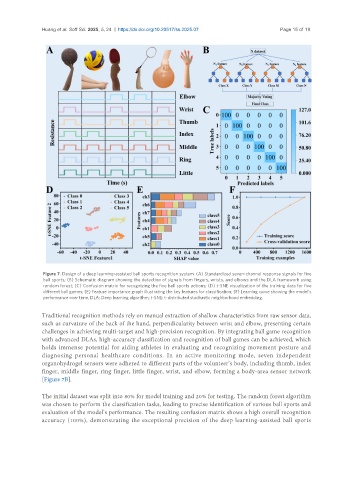
                Figure 7. Design of a deep learning-assisted ball sports recognition system. (A) Standardized seven-channel response signals for five
                ball sports; (B) Schematic diagram showing the detection of signals from fingers, wrists, and elbows and the DLA framework using
                random forest; (C) Confusion matrix for recognizing the five ball sports actions; (D) t-SNE visualization of the training data for five
                different ball games; (E) Feature importance graph illustrating the key features for classification; (F) Learning curve showing the model’s
                performance over time. DLA: Deep learning algorithm; t-SNE: t-distributed stochastic neighborhood embedding.


               Traditional recognition methods rely on manual extraction of shallow characteristics from raw sensor data,
               such as curvature of the back of the hand, perpendicularity between wrist and elbow, presenting certain
               challenges in achieving multi-target and high-precision recognition. By integrating ball game recognition
               with advanced DLAs, high-accuracy classification and recognition of ball games can be achieved, which
               holds immense potential for aiding athletes in evaluating and recognizing movement posture and
               diagnosing  personal  healthcare  conditions.  In  an  active  monitoring  mode,  seven  independent
               organohydrogel sensors were adhered to different parts of the volunteer’s body, including thumb, index
               finger, middle finger, ring finger, little finger, wrist, and elbow, forming a body-area sensor network
               [Figure 7B].

               The initial dataset was split into 80% for model training and 20% for testing. The random forest algorithm
               was chosen to perform the classification tasks, leading to precise identification of various ball sports and
               evaluation of the model’s performance. The resulting confusion matrix shows a high overall recognition
               accuracy (100%), demonstrating the exceptional precision of the deep learning-assisted ball sports

