


Page 101 - Read Online
P. 101
Page 8 of 19                          Huang et al. Soft Sci. 2025, 5, 24  https://dx.doi.org/10.20517/ss.2025.07


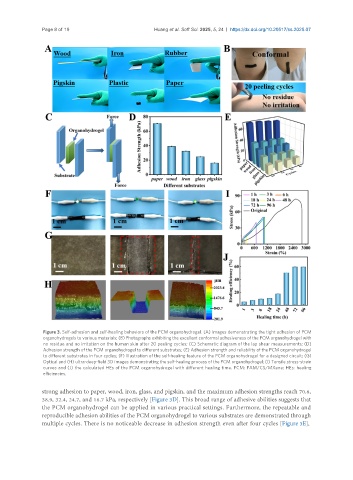
                Figure 3. Self-adhesion and self-healing behaviors of the PCM organohydrogel. (A) Images demonstrating the tight adhesion of PCM
                organohydrogels to various materials; (B) Photographs exhibiting the excellent conformal adhesiveness of the PCM organohydrogel with
                no residue and no irritation on the human skin after 20 peeling cycles; (C) Schematic diagram of the lap shear measurements; (D)
                Adhesion strength of the PCM organohydrogel to different substrates; (E) Adhesion strength and reliability of the PCM organohydrogel
                to different substrates in four cycles; (F) Illustration of the self-healing feature of the PCM organohydrogel for a designed circuit; (G)
                Optical and (H) ultra-deep-field 3D images demonstrating the self-healing process of the PCM organohydrogel; (I) Tensile stress-strain
                curves and (J) the calculated HEs of the PCM organohydrogel with different healing time. PCM: PAM/CS/MXene; HEs: healing
                efficiencies.


               strong adhesion to paper, wood, iron, glass, and pigskin, and the maximum adhesion strengths reach 70.6,
               38.9, 32.4, 24.7, and 16.7 kPa, respectively [Figure 3D]. This broad range of adhesive abilities suggests that
               the PCM organohydrogel can be applied in various practical settings. Furthermore, the repeatable and
               reproducible adhesion abilities of the PCM organohydrogel to various substrates are demonstrated through
               multiple cycles. There is no noticeable decrease in adhesion strength even after four cycles [Figure 3E],

