


Page 100 - Read Online
P. 100
Huang et al. Soft Sci. 2025, 5, 24  https://dx.doi.org/10.20517/ss.2025.07       Page 7 of 19


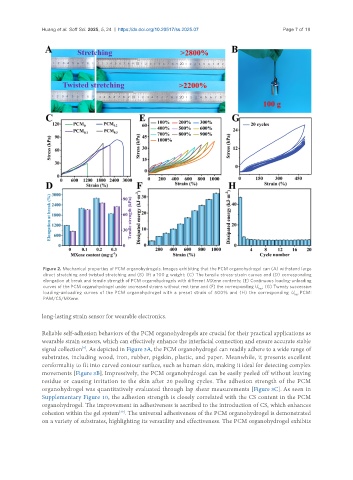
                Figure 2. Mechanical properties of PCM organohydrogels. Images exhibiting that the PCM organohydrogel can (A) withstand large
                direct stretching and twisted stretching and (B) lift a 100 g weight; (C) The tensile stress-strain curves and (D) corresponding
                elongation at break and tensile strength of PCM organohydrogels with different MXene contents; (E) Continuous loading-unloading
                curves of the PCM organohydrogel under increased strains without rest time and (F) the corresponding U ; (G) Twenty successive
                                                                                        hys
                loading-unloading  curves  of  the  PCM  organohydrogel  with  a  preset  strain  of  500%  and  (H)  the  corresponding  U . PCM:
                                                                                                    hys
                PAM/CS/MXene.
               long-lasting strain sensor for wearable electronics.

               Reliable self-adhesion behaviors of the PCM organohydrogels are crucial for their practical applications as
               wearable strain sensors, which can effectively enhance the interfacial connection and ensure accurate stable
               signal collection . As depicted in Figure 3A, the PCM organohydrogel can readily adhere to a wide range of
                             [9]
               substrates, including wood, iron, rubber, pigskin, plastic, and paper. Meanwhile, it presents excellent
               conformality to fit into curved contour surface, such as human skin, making it ideal for detecting complex
               movements [Figure 3B]. Impressively, the PCM organohydrogel can be easily peeled off without leaving
               residue or causing irritation to the skin after 20 peeling cycles. The adhesion strength of the PCM
               organohydrogel was quantitatively evaluated through lap shear measurements [Figure 3C]. As seen in
               Supplementary Figure 10, the adhesion strength is closely correlated with the CS content in the PCM
               organohydrogel. The improvement in adhesiveness is ascribed to the introduction of CS, which enhances
               cohesion within the gel system . The universal adhesiveness of the PCM organohydrogel is demonstrated
                                         [29]
               on a variety of substrates, highlighting its versatility and effectiveness. The PCM organohydrogel exhibits

